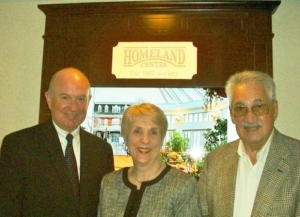
On the heels of glowing inspection reports, Homeland Center and Hospice prepare for future challenges

test

As Homeland Center celebrates a year marked by glowing state inspections and the ability to provide increased benevolent care, the kudos came with a word of caution.

“The foundation of our future success is to provide consistent quality for residents and patients who have entrusted the end of their lives to use,” said Barry S. Ramper II, President and CEO.

In the highly regulated health care field, few organizations reach Homeland’s level of quality, said President and CEO Barry S. Ramper II during the recently held annual meeting of the center’s boards of Trustees and Managers. He warned, however, that today’s success is not simply guaranteed tomorrow.

“The only way success will happen in the future is if we make it happen,’’ Ramper said. “The foundation of our future success is to provide consistent quality for residents and patients who have entrusted the end of their lives to us.’’

Homeland Hospice, which earlier this year started Central Pennsylvania’s only dedicated pediatric hospice program, continues to grow and receive superior quality assurance reports that set it apart from its peers.

“We have an unbelievably good staff that works with families,’’ Ramper said of Homeland Hopsice. “They provide a service that is almost broaching what most would believe to be impossible to do.’’

In keeping with its mission to help those in need, Homeland Center provided $3.3 million in benevolent care for residents, a 32 percent increase. The money benefits residents whose true cost of care is not covered by medical assistance and residents who have exhausted all of their assets.

“Our residents and patients are receiving a quality of care that sets us apart from other facilities,” said Peggy Purdy, Chairwoman of the Board of Managers.

To ensure that Homeland’s tradition of never asking a resident to leave because of financial reasons endures, Homeland is in the second year of its goal to increase its endowment by $20 million by the year 2020. As part of this goal, Homeland established The 1867 Society to recognize individuals and couples who have made significant, tax-deductible commitments to the endowment.  Charitable annuities, trusts, bequests, gifts of life insurance and real estate are among the donations that can support Homeland.

Earlier this year, 60 charter members were recognized in a ceremony unveiling The 1867 Society Wall of Honor, a digital display set in an attractive wood frame located in Homeland’s Sixth Street lobby. In addition to recognizing members who make significant donations, the display shows many of Homeland’s features.

Ramper pointed to two key elements of Homeland Center’s success: Certified Nursing Assistants and other front-line staff who give their all every day and a focus on lessons learned from the hospitality industry.

“I have researched Hilton, Marriott and others because in reality healthcare is a service organization,’’ he said. “There is no reason why our entire health care system cannot take what has been

learned in the hospitality industry and apply it.’’

“Together, we move forward with confidence and to sustain and build on our legacy established 148 years ago,” said Morton Spector, Chairman of the Board of Trustees.

It’s an approach that is clearly working: For the fourth year in a row, a poll of Harrisburg Magazine’s more than 30,000

readers resulted in Homeland Center being selected as the Readers’ Choice for Best Long-Term Care Facility. Homeland is also named as one of the nation’s best nursing homes by U.S. News & World Report and continues to be one of the few facilities in the region to receive Medicare’s top five-star rating.

“The quality assurance reports for Homeland Center and Homeland Hospice continue to show our residents and patients are receiving a quality of care that sets us apart from other facilities,’’ said Peggy Purdy, Chairwoman of the Board of Managers.

Purdy noted that Homeland’s historical contribution to the Harrisburg area was recognized this year by the Open Stage of Harrisburg in its performance of “Stories from Home: People Who Care.” In addition to looking at Homeland Center’s founding after the Civil War to care for widows and orphans, actors interviewed eight residents and portrayed their stories as monologues.

Morton Spector, Chairman of the Board of Trustees, echoed Ramper in saying Homeland cannot afford to lose focus.

“We will be dramatically affected by changes in governmental funding, the Affordable Healthcare Act, the demands of the boomer generation and yet unknown factors, Spector said.

“But Homeland has demonstrated that it does not falter from such challenges and does not waiver from its commitment to provide the highest quality of care in the most appropriate setting available,’’ he said. “Together, we move forward with confidence and to sustain and build on our legacy established 148 years ago.’’

New Members to the Board of Trustees:

  • Brice Arndt, DDS
  • Mrs. Sally Klein
  • Mrs. Karen F.  Snider

New Members to the Board of Managers:

  • Ms. Gail Holland
  • Ms. Deborah Brinser McDivitt
  • Mrs. Catherine N. Rauth
  • Mrs. Sue Shebosky
  • Mrs. Sherry Stout

Returning to the Board of Managers:

  • Mrs. Babs Phillips
  • Ms. Barbara Cleeland

Harrisburg police chief takes a dunk for Homeland Center at Summertime Fair

test

Harrisburg Police Chief Thomas Carter, sitting in the dunk tank, teased Richard Wise.

Harrisburg Police Chief Thomas Carter, who volunteered to help raise money by getting dunked, said he appreciates the prominent role Homeland Center plays in the community.

“You can’t throw,” Carter told the Steelton boy. Richard responded with a pitch that hit the target and sent Carter into the water.

Carter’s dunk tank appearance was the featured event at Homeland Center’s annual Summertime Fair, held Aug. 1, 2015. When Homeland staff met and exceeded his challenge to raise $7,500 for the resident activities fund, he took his perch on the dunking seat.

(See the PennLive coverage here)

Carter said he believes in Homeland’s mission and appreciates its prominent role in the same Harrisburg community where it was founded in 1867 as the “Home for the Friendless.”

“They are still friendly to the neighborhood,” Carter said. “They have a vested interest. I have that same vested interest. We have a natural love for the city.”

Homeland hires much of its staff from the surrounding community, where “neighbors look out for neighbors, and there’s very little to no crime,” said Carter, dressed in a sleeveless t-shirt and athletic shorts for his plunge. The dunking offered “an opportunity for people to meet the chief without all the official stuff on,” he said.

The total $8,500 raised before Carter’s dunking supports a range of activities, including music therapy for residents in the dementia and Alzheimer’s unit and in skilled care. Music therapy has helped Homeland reduce the use of psychotropic medications for dementia and Alzheimer’s patients below suggested federal levels.

“Our residents always look forward to spending time with members of the community,” said Barry Ramper II, Homeland President and CEO, who took the plunge after Chief Carter.

Monroe Rockmaker, of Harrisburg, attending the Summertime Fair with his mother, said she receives very good care and “seems very content. She seems to be at peace.” Music therapy, offered weekly by professional music therapists to improve cognition and interaction, reconnects his mother with the music she has enjoyed all her life.

Rockmaker recalled one session when a harp player brought a visible reaction from his mother, a classical music lover.

“You could feel the happiness,” he said.

Later in the afternoon, resident Carol Cruys took aim at another celebrity in the dunking seat – Homeland Center President and CEO Barry S. Ramper II. Like Carter, Ramper promised to be dunked if staff met the $7,500 fundraising goal.

Cruys tells everyone she meets that Homeland is “the place to be.”

“If you know somebody that needs help, this is the best place,” Cruys said. “Come and visit us, and you’ll see how great it is. There’s nothing you can’t like. They take excellent care of you.”

Amid the laughs of the crowd, Ramper took many falls into the tank, as children and Homeland residents sometimes got help with pushing the release button. After his 30-minute session ended, Ramper thanked Chief Carter for also getting dunked.

“He’s fully committed to Homeland,” Ramper said. “He and the entire Harrisburg Police Department are fully committed. They do an outstanding job, not only for us but for the city.”

Ramper said the annual fair is an event anticipated by Homeland’s residents and neighbors alike. Money raised through the fair and other efforts helps Homeland continue to provide unmatched service in the challenging health care environment, he said.

“Our residents always look forward to spending time with members of the community,’’ said Barry S. Ramper II, Homeland’s president and CEO. “The fair also provides an opportunity for visitors to learn about Homeland and see the quality care that is available for their loved ones.’’

Theater production mines Homeland history for stories of caring

test

Since 1986, Open Stage of Harrisburg has given theatrical life to stories of love, memory, conflict, and courage.

Resident Gloria Jackson says she is pleased every day to see her son Albert, who is one of Homeland’s well-known community receptionists.

Since 1867, Homeland Center has provided shelter, care, and dignity for people with stories of their own to tell.

So it was only natural that these two highly regarded institutions join forces. For the 2015 production of “Stories from Home: People Who Care,” Open Stage turned to Homeland for true stories demonstrating how a community cares for those who can’t care for themselves.

Stories from Home: People Who Care” is the fourth and final production in Open Stage’s series on how the people of Harrisburg have shaped its character and its neighborhoods. Homeland’s storied history made it an ideal subject – the tale of 18 women who, after the Civil War, raised money, donated land, worked with nine churches, and enlisted businessmen to help create a home for the many destitute widows and orphans in their midst.

“They made it happen,” says Open Stage Education Director Anne Alsedek.

Today, Homeland has grown into a continuing care community offering skilled care, personal care, a specialized dementia unit, and short-term rehabilitation. No resident whose resources are depleted has ever been asked to leave. Still, Homeland remains rooted at the spot where “The Home for the Friendless” was founded in 1867.

“It’s extraordinary,” says Alsedek. “The culture there, the environment, the atmosphere is extraordinary. All the residents can talk about is how well cared for they are and how well treated they are. They’re given freedom. They’re given autonomy. They’re quite content there. The whole place was founded on extraordinarily humane principles, and those principles have been maintained for almost 150 years.”

For “Stories from Home,” Open Stage actors interviewed eight Homeland residents and wrote their stories as monologues. One resident, Geoffrey Davenport, was born in Harrisburg to the family that owned the fondly remembered Davenport’s Restaurants. He enjoyed sharing his story with Open Stage actor Joseph Osborne, telling of his years as a restless young man who was angry until a diagnosis of multiple sclerosis finally explained why his body wouldn’t behave in a way that felt normal.

“I’m in a good place, and the people are good to me,” says resident Geoffrey Davenport.

“You would tell me something about your life and I wanted to be that way with my life, and it wasn’t that way and I didn’t know why,” said Osborne as his Davenport persona.

After years of working in restaurants and hotels, Davenport returned to Harrisburg. In 2014, he came to Homeland, where staff is attentive, the food is good, and “the right people are in the right jobs.”

“I’m okay now,” Davenport says. “I’m in a good place, and people are good to me.”

Another resident, Gloria Jackson, told actor Jennette Harrison of her life as an athletic young woman who grew up to be the mother of seven children. The diehard Pittsburgh Steelers fan worked as a nursing assistant in a retirement community, making sure that younger staff took good care of residents.

After suffering a stroke, Jackson moved to an area retirement community but didn’t like it there. She moved to Homeland, where she is pleased every day to see her son Albert, who is one of Homeland’s well-known community receptionists.

“I love it,” said Harrison in her portrayal of Jackson. “I have peace of mind.”

Homeland was the perfect centerpiece for “Stories from Home” and its discussions about a community’s responsibility to care for its members.

“Homeland is about respect for other people,” says Alsedek. “It’s a model of how you are your brother’s keeper, or your sister’s keeper. You just treat people with dignity.”

60 charter members of The 1867 Society of Homeland honored

test

Generous contributions make it possible for Homeland Center to provide in excess of $2 million in annual benevolent care

HARRISBURG, PA (Friday, May 8, 2015) – Sixty charter members of the new 1867 Society of Homeland were honored today for generous donations that make it possible for Homeland Center and Homeland Hospice to care for those in need.

From right: President/CEO Barry S. Ramper II; Morton Spector, Chairman of the Board of Trustees; and Peggy Purdy, Chairwoman of the Board of Managers, unveil The 1867 Society of Homeland Honor Board.

The 1867 Society was created and tasked with raising $20 million by 2020 to support the more than $2 million in benevolent care Homeland provides annually. All donations are tax deductible.

“The pledges these 60 charter members have made to our endowment brings us more than halfway to our goal,’’ said President /CEO Barry S. Ramper II. “Their generosity guarantees that future generations of Central Pennsylvanians will be able to count on the quality senior care Homeland Center and Homeland Hospice provides.’’

During recognition ceremony, The 1867 Society Wall of Honor was unveiled in Homeland’s Sixth Street lobby. The digital display, set in an attractive wood frame, highlights the Society’s members and many of Homeland’s features.

Ramper pointed to Homeland’s policy of caring for residents at Homeland Center, even when they have exhausted their financial resources. It’s a level of commitment that requires the public’s help, he said.

“Homeland Center was founded because our community recognized the need to care for widows and orphans following the Civil War,’’ Ramper said. “Though our mission has changed, the demand for our services has never waned.’’

Homeland is a licensed not-for-profit Continuing Care Retirement Community and a Five-Star Skilled Nursing Care Facility. Occupying a full city block in uptown Harrisburg, Homeland offers personal and skilled nursing care, as well as respite and rehab services. A 24-bed wing houses the unit dedicated to the special needs of those with Alzheimer’s or dementia-related diseases.

In keeping with its dedication to serving the community, Homeland Center established Homeland Hospice to help patients in the end stages of life and provide emotional support for their families. It is the only service in the region to offer a specialized pediatric hospice program. Homeland Hospice provides hospice care in patient’s homes and facilities.

“I’ve heard from many families who tell me how much it means to them to know that no matter what, their father or mother will never suffer the stress of having to find a new home,’’ said Morton Spector, Chairman of the Board of Trustees. “Donations to the 1867 Society ensure Homeland’s legacy can continue.’’

To learn more about the 1867 Society of Homeland and ways to contribute, contact Betty Hungerford, Director of Development, at 717-221-7727 or bhungerford@homelandcenter.org

###

Since 1867, Homeland has provided quality care to the residents of Central Pennsylvania. In addition to offering skilled nursing and personal care services, Homeland also offers hospice services. For more information, go to www.homelandcenter.org or www.homelandathome.org

Homeland Center’s rehab brings a holistic approach to wellness

test

Marianna Bjurstrom doesn’t let severe arthritis keep her from enjoying the day trips and activities that Homeland has to offer. Her rehabilitation services have helped her retain as much mobility as possible and even taught her to use a power wheelchair.

“I don’t want to be a couch potato,” she says.

Homeland resident Marianna Bjurstrom and Occupational Therapist Manager Margaret McCabe.

Homeland partners with Genesis Rehab Services, a national provider, to offer rehab for Homeland guests. They may be long-term residents, or they may choose Homeland for rehab stays of a few days or weeks while recovering from a hospital visit or injury. Some are Homeland Hospice patients and receive rehab services in their home.

All get the same level of quality service that’s infused into the spirit of Homeland.

Genesis staff members include physical, occupational, and speech and language therapists, all skilled and educated in their areas of expertise. They work as a team with Homeland’s nurses and social services, including nurses and social services, taking a holistic approach to the needs of every patient, says Sherrie Knaster, area director for Genesis Rehab.

Help with a variety of conditions

Patients come to rehab for a variety of reasons, whether they’re suffering from the effects of a fall, trying to maintain cognitive abilities in the face of dementia, or recovering from surgery. No matter the reason, the rehab team focuses on every aspect of the patient’s circumstances.

“Is there a medical condition that’s changed?” says Knaster. “From a patient point of view, what is their mobility? What’s their balance? What’s their strength? We also look at it from an occupational point of view, how are they interacting with their environment, to make sure they’re getting all their daily activities accomplished in a safe way?”

In all cases, “the patient comes first,” says Knaster. Families are included in every step, while patients themselves set the goals meant to get them to the next level.

Knaster recalled one patient who came to rehab through Homeland Hospice. Genesis provided services in the home, working toward the goal of helping the patient get out of bed and join the family in the living room on Christmas Day – a goal that was achieved.

“When you keep things patient-centered and you listen to their goals, then you get the outcomes you want,” says Knaster.

Improving quality of life

Rehab services have helped Homeland resident Veronica Stibitz manage the effects of conditions that include scleroderma, a condition that can affect the skin and internal organs. A heat lamp and massage make her hands feel better. After emerging from a period when she was bedridden, her therapists helped her recover her balance.

“They’re encouraging, and they’re people persons,” says Stibitz. “They don’t push their patients so we feel uncomfortable. You feel very relaxed.”

Even when she has reached her goals, there are reviews and checks to “help you get back and make sure you’re okay,” says Stibitz.

Much of the work of rehab is about maintenance of abilities, especially in the case of patients with dementia, which, as Knaster notes, is a disease process that robs patients of the ability to accomplish everyday tasks.

“We look at how we can keep that person — who might deny having cognitive changes — engaged so they can stay well and do the daily activities that we take for granted,” she says.

“Your therapy, your way”

The rehab team can conduct home evaluations, to assess environment and safety for patients returning to their homes. It’s all part of providing “your therapy, your way,” says Occupational Therapist Program Manager Margaret McCabe.

Patients receive services in their rooms or in the cheery rehab space that opens to a Homeland garden. McCabe once took a cervical collar to a patient’s home, and “they thought it was the best thing since sliced bread.”

“It was such a simple fix, but it was huge for them,” she says.

Bjurstrom participates in therapy to keep her stiffened joints moving, while her Pronto power wheelchair propels her around Homeland and on trips. The therapy team helped her acquire the donated chair and provided three weeks of training in its safe use.

“It’s kind of like driving a car,” says Bjurstrom. “You have to be on the lookout for people coming and going, and you have to be able to keep going in the right direction and not roll over people’s toes.”

The longstanding relationship between Homeland and Genesis Rehab Services is built on the strengths of each, says Knaster – Homeland’s service-oriented philosophy, and Genesis’ extensive network that assures a free flow of ideas and up-to-date services.

“If you partner with the right people, then you can use their experience and do what you need to do to have the best outcome,” says Knaster.

Bjurstrom enjoys working with her therapists, who are all “very nice and always willing to help.”

“Their hearts are all in it,” she says. “I’m glad I’m here. I really am.”

Homeland is proactive in preventing weight loss

test

Unintended weight loss in the elderly is serious business. When the body is forced to draw on stored protein for energy, the antibodies that ward off illness are diverted, and a cascade of negative health consequences can follow.

Homeland Center dietitian Christina Dinger, left, gives resident Lorraine Englander a nutritional supplement. Dinger is part of a team that ensures residents maintain a healthy weight.

“If you have an 80- or 85-year-old who’s beginning to lose weight, that’s associated with multiple issues, and things spiral out of control,” says Homeland Director of Nutritional Services Yolanda Williams. “There can be skin breakdown, dehydration and infections because the immune system is weakened.”

Homeland’s unique approach

Spotting, preventing and treating weight loss demands true detective skills, and Homeland Center developed an individualized approach – unique to nursing homes – that’s worthy of a “CSI” episode. Instead of giving nutritional duties to multi-tasking nurse’s aides, Homeland assigns a nutrition-at-risk aide to the care teams on each floor in skilled care and in the Ellenberger dementia/Alzheimer’s unit.

“Their sole responsibility is to make sure that residents receive their supplements and are adequately hydrated,” says Williams. “They focus on the prevention of weight loss in the first place, but if a resident does lose weight, they focus on providing interventions to help them stabilize.”

The nutrition-at-risk aide tracks the weight and other indicators of each resident, watching daily for trends that signal weight loss and then investigating the causes. A variety of issues can trigger weight loss: depression, loss of appetite, loss of a loved one or conditions such as urinary tract infections. Some residents might need assistance with eating but are too proud to ask, says Williams. The key is spotting the root cause early.

“We catch weight loss before it starts causing real problems,” she says.

Eating favorite foods encouraged

Once the problem is spotted and a cause identified, the nutrition-at-risk aide works with family members and other staffers to customize a solution. It might mean adding a favorite yogurt brand to the diet to encourage eating or finding opportunities to pack more calories into every bite.

“We always focus on preferences,” says Williams. “If they want salads and like veggies, we don’t take those away, but we work in the calories elsewhere. We may have a resident who loves ice cream, so they get ice cream with their breakfast. Maybe we put five pats of butter in their oatmeal.”

Nutrition-at-risk aide Christina Dinger enjoys “being able to build a rapport with the residents.”

“I’m then able to tailor interventions to each individual resident,” says Dinger, a dietetic technician, registered, or DTR. “When we have to address their weight loss, it’s something that fits into their lifestyle. Sometimes we’re even able to prevent weight loss because we’re able to pick up on triggers before it becomes an issue. I enjoy working so closely with the residents and their families.”