
Homeland’s Easter egg hunt fun for all ages
test

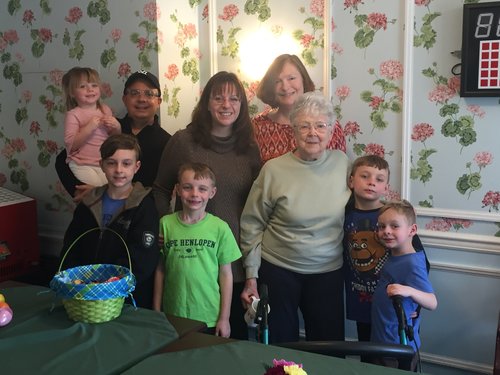
Homeland's Easter egg huntAs she watched her grandchildren happily opening the colored plastic Easter eggs, Homeland Center resident Jean White mused the adults get as big a kick out of the annual hunt as the kids.

“I like it that Homeland encourages everyone to participate and includes families,’’ Jean said, taking in the happy squeals as the grandkids discovered favorite candies. “This is great for the kids and the grownups and I actually think the grownups enjoy it more, getting to watch the kids.’’

Homeland’s staff stuffed 1,000 brightly colored plastic eggs with treats and hid them throughout Homeland Center’s units, including Skilled Nursing, Personal Care and the Ellenberger memory care unit, said Gillian Sumpter, Director of Activities.

In addition to the egg hunt, kids were lining up in Homeland’s 1950s-style diner for face painting by local artist Taqiyya Muhammad. A visit by the Easter Bunny, also known as local performer Jimmy Edwards, was on the day’s agenda as well.

“I like the peanut butter eggs,” said Jean’s 9-year-old grandson, Luke, examining his sugary haul with siblings Leo, 7, Jacob, 6, Matthew, 4 and Sarah.

Luke’s mom and Jean’s granddaughter, Heather LaCour, looked on with her husband, Andy, and smiled.

“This is great – I can tell the residents enjoy it and I know their grandmother enjoys it,’’ Heather said, adding that her family loves Homeland’s summer picnics and festival. “I think it’s good to have events that give families the opportunity to get together. It’s important that Homeland is family-friendly.’’
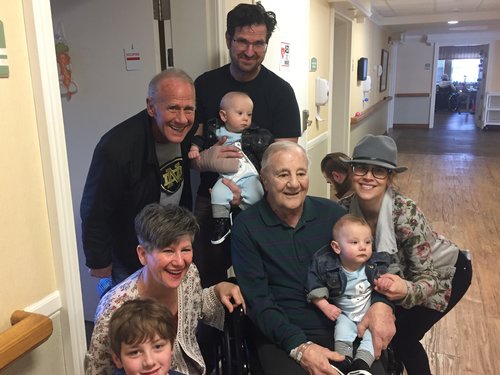
Homeland's Easter egg huntElsewhere in Homeland, Gilbert Leo happily looked on as three generations of his family enjoyed the fun.
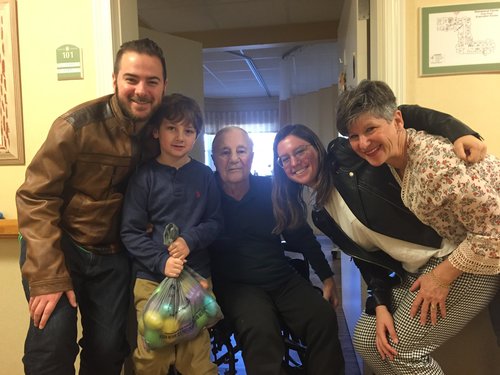
Homeland's Easter egg hunt“You get excellent care,’’ Gilbert said of Homeland.

His daughter, Michele Pease, said she could see how much her father and the other residents were enjoying seeing family. Michele said she appreciates the effort Homeland makes to plan these kinds of events.

Michele was joined by her brother, Tim Leo, and both of their children and grandchildren. Michele’s adult children, Morgan and Vincent, had fun watching Vincent’s 7-year-old son, Kamden, hunt for treats. Tim’s daughter, Tara Leo Auchey, was there with her husband, Caleb and their 10-month-old twins, Cassius and Bowie.

“It really uplifts my Dad,’’ Michele said. “These events really make Homeland feel like home and make the residents feel more connected.’’

Brother Tim agreed.

“I’m thrilled with the care they receive,’’ Tim said. “The staff pays attention to the residents and events like this bring everyone together.’’
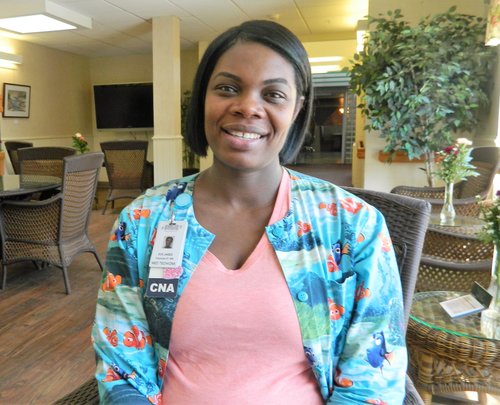
Employee Spotlight: CNA/medication technician Eve James believes in making a difference

test

Eve JamesEve James was a teenaged Homeland volunteer, helping residents with little things throughout the day. She quickly learned how much a small act of kindness could mean.
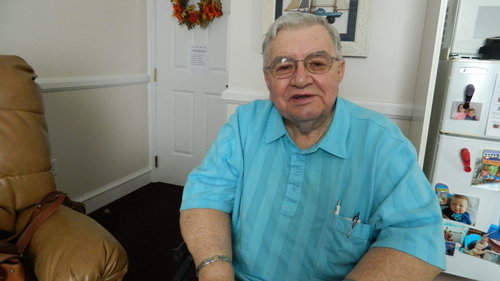
“We had a resident who didn’t have a lot of family, and she loved to do crossword puzzles,” says Eve. “I went to the store and got some crossword puzzles, and they were a dollar. Two books. She wept with gratitude. It made me feel so good that I could make her day.’’

Those two years as a volunteer led to a long-term commitment to Homeland. Today, Eve, 35, is a CNA/medication technician, working for Homeland since December 1999.

She began volunteering for Homeland at age 14 as an opportunity to “do something different,” especially outside a busy household of eight children – her five sisters and two brothers. She always looked for ways to help, from reading newspapers aloud to residents and giving manicures to assisting with correspondence.

“I always felt that I made a difference, even if I touched just one life that day,” she says.

Eve volunteered until she was 16, when she went to work at McDonald’s. In those days, she didn’t quite get what school was all about, so she dropped out before graduating. At age 18, she came to work for Homeland in the activities office. Since that day in 1999, she has built “so many memories connected to Homeland.”

“Homeland almost raised me,” she said. “I had a lot of my firsts here. I lost my father in 2002 while working at Homeland. I almost went into labor there with my first child. One of the nurses counted my contractions. She said, ‘I think we need to call your doctor.’”

She also credits Homeland with teaching her valuable life lessons about care and respect and to look for ways to help people outside the workplace. While at Homeland, she also started rethinking the value of education.

“After my first son was born, I knew I needed to do better,” she says. “I had to get my GED. I had to continue. I didn’t want him to think It was okay to drop out of school, so I went back, and I finished.”

She started pursuing studies in human services at Harrisburg Area Community College – perfectly suited to her interest in helping and being around others. At Homeland, she has worked in a variety of roles, including as activities coordinator, personal care activities manager, and as an aide in the Ellenberger memory care unit and skilled care. Homeland then trained her to dispense medications for her current position as a CNA and certified medication tech.

To succeed at Homeland, “you must be a genuine person,” she says. “You catch little glimpses of the differences you’re making. It can be the smallest thing, even with the different rapport you have with different residents.”

Outside of Homeland, Eve values the time she spends with her 14-year-old son A.J. Jones, 19-month-old son Mason Brown and fiancé Robert Brown. With another baby on the way – a little brother to her boys – Eve happily describes herself as a homebody.

“The older I get, the more I recognize what’s really important,” she says. “Over these last three or four years, I’ve come to recognize what I thought was important before is insignificant.”

She believes that she and her fellow Homeland CNAs “advocate for the residents on a daily basis,” making sure they get what they need and want – even if it’s ordering up a grilled turkey and cheese on wheat bread that’s not on the day’s menu.

“It’s not just a job,” she says. “Anyone who works in this field has to have a heart.”

Resident Spotlight: Donald Rudy’s work offers delicious memories

test

Donald RudyIn the lunch meat business, there’s one thing you learn by doing.

“I had to learn to slice,” said Homeland resident Donald Rudy. In those days, slicers didn’t have automatic stackers, so the operator had to slice and stack as he went along. “You’ve got to have good coordination, and you had to be fast. It was a knack.”

For 22 years, Rudy’s Farmer’s Market, in the Progress area of Harrisburg, served customers the best in meats and cheeses. It continued a tradition started by Rudy’s father, who in 1919 opened Frank B. Rudy and Sons in the city’s Broad Street Market.

Don and his brother, Burton, got into the business, and their cousins had similar stands in other markets. Shipments of lunch meats and massive wheels of cheese would arrive, and everyone would get to work.

At Eastertime, there were whole hams to be cut. “One Easter, we sold 500 hams,” said Don. “Easter, Christmas, and Fourth of July were our big weeks.”

The Fourth of July also was a big day in Don’s life because that’s when in 1954, he married his wife, Frances. They met as teens at Broad Street Market, where Frances’ father, Lynn Farver, owned a produce stand. The only problem: She lived in Mechanicsburg, and he lived in Progress.

“We bus-dated,” Don said. “I’d take my bus, and she’d take her bus. It depended on where the movie was.”

Frances was 18 and Don was almost 19 when they got married. He kept working for his father. She joined the business, too, and also worked for a food producer. Everywhere Fran went, she spread joy. He remembered one day when they took separate seats on the bus, and he could hear her chatting with someone. He asked if she knew that person. “No,” she said. They just happened to be seatmates.

Their lives revolved around family. Don and Frances had four daughters. Don, his brother, and his parents built neighboring homes. Every Sunday, everyone from both sides of the family would gather at Don and Fran’s house for sandwiches, pinochle, and shooting pool.

In 1968, they decided to build their own market on Route 22, on the outskirts of Harrisburg. At Rudy’s Farmers Market, shoppers found everything they needed, sold by a variety of vendors – meats, cheese, seafood, bread. A grocery section carried canned goods and other staples.

Donald Rudy with daughtersUntil it closed in 1990, the market was “a gathering place,” said Don’s oldest daughter, Debbie Kurtz, who was visiting recently along with her sister, Cindy Thomas. “You always saw people at the same time every week. You knew who would come on Friday nights, and they would make hours of it.”

Don moved to Homeland after Frances came for rehab. In the months before her death in January 2018, she formed strong bonds with her Homeland caregivers.

“They took terrific care of my mother,” Debbie said. “They were very informative. They genuinely liked her, so there was a rapport.”

Today, Don is the proud grandfather of 11, and great-grandfather of 15, ages 1 to 23. He likes life at Homeland. He enjoys Sunday services. When he can find three other players, he enjoys playing pinochle.

“I have a nice apartment,” he said. “I like the staff here.”

Pianist Domingo Mancuello brings ragtime melodies to Homeland

test

Domingo Mancuello told the Homeland Center audience that he would play three songs by a little-known songwriter names Isham Jones.

“One is called ‘Sweet Man,’ and the other is called ‘Sugar,’” he said. “And I’m not going to tell you the name of the third song because you’re going to know the title, and when you recognize that song, I want you to shout it out. Shout it out loudly, because this piano is loud.”

As the medley approached the end of the second tune, Mancuello burnished a few chords on the piano, slowed down the pace, and launched into a song that was recognizable in the first three notes.

“Sweet Georgia Brown!” Homeland residents shouted with delight.

On a Monday afternoon in early March, the young Mancuello brought an old form of music to Homeland. Under his fingers, the sounds of ragtime practically exploded from Homeland’s Steinway grand piano, a gift from a former resident.

“This is a great piano,” he said during his presentation. “It was definitely made in the 1920s because it feels good under my fingers.”

The large crowd of Homeland residents gathered in the Main Dining Room appreciated the serendipity. Toes tapped and heads nodded as Mancuello played familiar tunes and introduced lesser-known compositions, almost all from ragtime’s heyday in the first half of the 20th century.

Mancuello has played piano since age 4 – he’s now 25 – and discovered ragtime when his grandfather sang with a barbershop quartet. He and his grandfather were prowling antique shops, hunting for phonograph needles, when he heard a player piano for the first time. He was transfixed.

Today, he is production assistant at Fulton Theatre, Lancaster, while also pursuing his passion for ragtime. He tries to preserve an old tradition while refreshing it for the 21st century. He even played two of his own compositions for Homeland residents, including one soon to appear on “Ragtime Wizardry 2,” a compilation of new ragtime pieces from Rivermont Records.

“I don’t frown on modern music because what I’m playing was once the loud music,” he said.

Music wasn’t Mancuello’s only early love. As a child, he was obsessed with Rocky and Bullwinkle cartoons, not only watching the show but delving into its origins.

“I read books on how it was made, the animation process, how it was produced, and how the producers lived their lives to be the people who made Rocky and Bullwinkle,” he said after his performance for residents. “The show itself brought me so much joy that I thought, ‘How do I create something like that?’ My whole M.O. is, let’s just try to make people feel happy.”

During his Homeland performance, residents happily sang along when they knew the words to the songs. They joined in with “Ain’t She Sweet,” “Yes, Sir, That’s My Baby,” and “Has Anybody Seen My Gal?” When Mancuello played “Sweet Georgia Brown,” someone whistled the tune, just as it’s been performed for decades as the Harlem Globetrotters’ theme song.

Mancuello, veteran stage manager of many theatrical productions, has a quick smile and a relaxed manner. He thanked the residents and the sponsors who made his performance possible, Donna K. Anderson, president and CEO of On-Line Publishers, Inc., and her husband, Stan Anderson.

“It gives me such great pleasure to get to play this music for people because normally it’s just me in my apartment with a piece of sheet music,” he said.

Resident, Naomi Packer, called the performance “wonderful.”

“He brought back memories of my mother,” she said. “She was quite a piano player. She played all of this ragtime, but she also played very soft, smooth music. She was a great person, too.”

At the conclusion, resident Phoebe Berner stood up to thank Mancuello on behalf of everyone in the room.

“When this young man plays on Broadway, we can say we saw him at Homeland,” she said.

It’s a date: Homeland couples reminisce over Valentine’s Day lunch

test

Happy Valentine's Day!Love was all around Homeland Center on Valentine’s Day. Visitors were greeted with a cheery “Happy Valentine’s Day” and the sight of red streamers, balloons, and flowers at every turn.
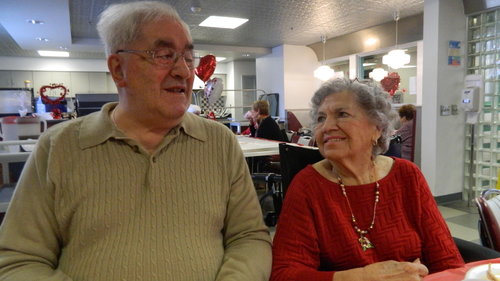
In the Main Dining Room, a volunteer dressed in red handed out felt hearts to residents having lunch. Throughout the week, staff wore red and hosted Valentine’s Day socials for the residents.

And in Homeland Center’s unique 50s-style diner, residents who are couples were treated to a special lunch of Italian favorites – spaghetti and meatballs, baked ziti, Italian sausage with peppers and onions, and a bright salad of mixed greens.

It was Homeland’s way of sharing the love that permeates the building year-round, but especially on Valentine’s Day.

“We try to do things so they can enjoy the holiday,” says Activities Coordinator Latoya Venable.

About 14 couples call Homeland home. Among those enjoying the special lunch were two couples with a combined 136 years of married bliss.

Valentine’s Day lunchMildred and Tom Anthony met at a weekly dance in Frackville, Tom’s hometown in the heart of the Pennsylvania coal region. She came from nearby Mahanoy City. Both admit that Tom wasn’t a very good dancer, but she liked his personality. One year later, they got married in Frackville. Today, they have been married 68 years.
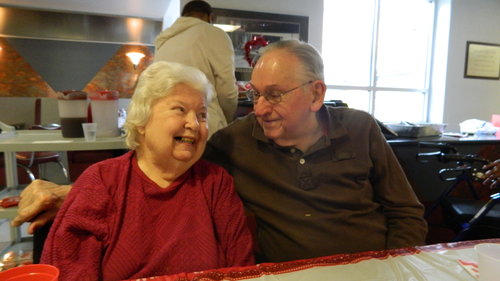
He was a meat cutter by trade, first in his family store, and then for Acme markets. She managed a bank branch.

“It was interesting and busy, and I met a lot of people,” Mildred says.

They had an active life, raising two children and getting outdoors for adventure whenever they had the chance. They had a boat. They had jet skis. They had a lake home near Jim Thorpe, Pennsylvania.

“In the wintertime, we had snowmobiles,” says Mildred. “We would go across the lake and up into the mountains on our snowmobiles.”

Typically, they didn’t do anything special on Valentine’s Day, other than go out to dinner. From Tom’s perspective, gifts for Mildred didn’t have to wait for a special occasion. Some of her most beautiful jewelry came from their visits to the country of Lebanon, where his family is from.

“Whatever she wants, she gets,” he says. “She sees a diamond, she can get it.”

Valentine’s Day lunchSitting at the next table, Colleen and Lester Grotzinger were sharing the latest in a long line of Valentine’s Days together. They were high school sweethearts who began dating “as soon as we could handle our parents,” says Colleen. They knew each other from school, but at a New Year’s Eve Party, they started talking, which led to their first date.

Today, they have been married 66 years.

Married in 1951, Colleen graduated from college, and Lester was called up for military service. After serving for two years in anti-aircraft artillery installations along the East Coast, Lester launched a career as a mechanical engineer and Colleen became a middle school teacher.

They have four children, two boys and two girls. When the Grotzingers weren’t working, they saw the world, visiting the Bavarian village of Lester’s ancestors and meeting some of Colleen’s relatives in Ireland.

For Valentine’s Days in the past, they did “nothing in particular,” says Colleen. “Maybe go to a movie.” The Homeland Valentine’s Day couples lunch was “a nice idea,” she added. For Lester, it was a chance to think back on their time together.

“A lot of years,” he says. “A lot of years.”

“Good years,” says Colleen.

“Absolutely,” says Lester.

Resident Spotlight: Colleen and Lester Grotzinger savor an active life

test

Colleen and Lester GrotzingerSometimes, high school sweethearts blossom into sweethearts for a lifetime.

Colleen and Lester Grotzinger knew each other from around their high school in the northcentral Pennsylvania town of Renovo. At a New Year’s Eve Party, they started talking, which led to their first date.

Today, the recent Homeland residents savor 66 active and adventurous years together

Married in 1951, Colleen had just graduated from college, and Lester had just finished basic training after his Pittsburgh-based National Guard battalion activated for service. The Korean War was underway, but the Army didn’t send Lester to Korea. He served in anti-aircraft artillery installations along the East Coast.

“Most people don’t even know that at one point, U.S. cities were protected by anti-aircraft artillery,” he says. “The U.S. was afraid of Russia bombing East Coast cities.”

While he served two years in the Army, Colleen lived in off-base apartments or back home in Renovo. When he left the service, he finished his studies at Carnegie Mellon University and launched a career as a mechanical engineer.

Les always knew he wanted to be an engineer. Growing up, he helped his dad around the house, building things and trying to understand how they worked. He devoted his career to a company that manufactured equipment – often rotating, high-speed compressors, steam turbines, and gas turbines – for chemical plants and refineries.

“They were big machines,” he says “Some of them were up to 200,000 horsepower. I had a very good career.”

Colleen was a graduate of the University of Pennsylvania who majored in elementary education. In those days, she says career choices for women were limited to teaching or nursing. At Penn’s exclusive Wharton School of Business, women weren’t even allowed in the building. When the Grotzingers returned to Penn for her 50th reunion, the group was waiting for a visit by the university president. The president’s car pulled up, and out stepped a woman.

“Things have changed just a little bit,” Les remarked to Colleen.

Today, adds Colleen, “I have grandchildren going there now.”

Colleen taught language arts in a middle school. Some say that’s a difficult age to teach, but she learned to have fun with her students.

“They were funny, in a comical way,” she says. “They want to make each other laugh, but they also made me laugh.”

Living in the southwestern Pennsylvania town of Greensburg, she was active in the League of Women’s Voters. For 35 years, both were active in a book club that read “anything and everything,” Colleen says, and even sometimes gathered on New Year’s Eve to do a play reading.

They also took on the challenge of renovating a fixer-upper, which they purchased after Les got out of the Army and had little money. With his skills as a handyman, he did much of the work, replacing windows and wiring, plumbing and ductwork.

“Everything Colleen wanted, we added in one fell swoop,” Les says. “A big addition for a living room and a fireplace and a two-car garage and a patio, all in one swoop.”

Les’ work took him around the world, sometimes to remote spots in North Africa or western Canada. When it was possible, Colleen came along. They have traveled to all 50 states, plus Canada, the Caribbean, England, and Europe. In Germany, they visited the Bavarian village of Lester’s ancestors. In Ireland, they met relatives of Colleen’s still living in the family homestead near the Cliffs of Moher.

Colleen couldn’t pick a favorite spot among their travels. She’d be happy to “go back to any of them.” Lester recalled a memorable trip to Italy, where he appreciated “the culture and the openness of the society.”