Resident Spotlight: Rosa Walker votes for 60 years

test

Rosa Walker is the granddaughter of a slave who endured racism in the segregated South. She remembers the heartbreak over such tragedies as the 1963 killing of four girls in an Alabama church bombing. In the midst of the nation’s civil-rights struggles, she and her husband decided there was one way to help drive change: They would vote in every election.

Homeland Center resident Rosa Walker loves to get outside and enjoy Homeland’s gardens and fountains.

Sixty years later, Rosa Walker, 94, has kept that pledge, never missing a vote. About 10 years ago, after her 50th year of consecutive voting, she and her husband, World War II veteran William M. Walker, were inducted into the Pennsylvania Voter Hall of Fame.

Today, the Homeland Center resident remembers that decision, made in the era when African-Americans were struggling to end segregation and secure equal rights.

“There was all the upheaval in the country, and people were dying for it,” she says from her room at Homeland. “My husband and I decided that if they could die for it, the least we could do was vote. We made that commitment to each other, and we kept it.”

Walker grew up in the South Carolina home of her grandparents. Her grandmother, Lavinia White, was born a slave. The family were sharecroppers on a cotton farm.

“They were one step away from slavery,” she says. “It was a horrible life. It was the saddest life because of the conditions you lived under. We walked to school for miles. We didn’t have proper food. We did the best we could on the farm because there was no light, no gas. Everything was outside. You had a pump, and that was your water. You had a fireplace, and that was your heat.”

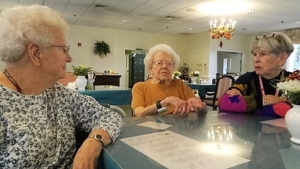
Beverly Walker, right, visits her mother, Rosa Walker, the granddaughter of a slave who has voted in every election for 60 or more years.

Seeking a better way of life, she went to live with loving relatives in Washington, DC. She worked as a maid in an upscale apartment complex, where she met her husband, who was also working there. He served as a first sergeant in the U.S. Army in Europe during World War II and was on his way to the Pacific, readying for a possible invasion of Japan, when the war ended.

In 1950, the couple moved to Harrisburg. Though they encountered segregation in the North, too, they eventually purchased a home in Uptown Harrisburg, near Homeland, and raised two daughters. “My husband and I worked night and day to find a better life for our kids,” she says.

Walker remembers all the U.S. presidents during her lifetime. Jimmy Carter and Harry Truman were “true men” and “good people,” she says. “The rest of them had their problems, all of them, including Roosevelt.”

Voters have the power to remove even rich people from their elected posts. “I can’t take your money, but I can take you out of that seat,” Walker says.

William Walker died in 2006 and is buried at Indiantown Gap National Cemetery. Since Rosa Walker moved to Homeland, her daughter has taken her to vote at the Neighborhood Center on Third Street.

“Right now, I’m still voting,” she says. “If I’m alive, I vote. Even though I’m incapacitated, I’m still going.”

Employee Spotlight: Barbara Jones sees residents as the sun and solar system of Homeland

test

Barbara Jones sees residents as ‘the sun and solar system’ of Homeland.

Whether she’s laughing with co-workers or chatting with residents, Barbara Jones loves working at Homeland Center.

Barbara Jones, right, assists co-workers, including Assistant Director of Finance Lori McMichael, in the range of fiscal matters that keep Homeland Center operating smoothly.

“When my life gets crazy, I love to come in, get at my desk, zone out, and focus on my work,” says Jones, Homeland’s fiscal assistant. “The people here are phenomenal. The people I work with in my office — the amount of work they do and their experience and how smart they all are just blows me away.”

Jones was working at another area retirement center when a co-worker left for Homeland, and she knew she wanted to follow.

“I like to say I was on the wait list,” she says. Since joining the fiscal staff in February 2016, she helps with accounts payable, payroll, and other tasks that help her colleagues “keep their jobs rolling along.”

“I just hope to help make their jobs easier and be there to carry the extra,” she says. “I’ve learned so much. I’m just the assistant, and I love it. I love to assist people.”

Jones has a busy life outside of Homeland. She and her husband, Kenneth White, have four daughters, ages 13 to 26, and an infant granddaughter. They also have a chocolate lab puppy named Toby, cats named Marco and Miss Baby, and a 100-pound African spurred tortoise named Dido.

About that tortoise: A snake-enthusiast friend was going to a reptile show, and they asked him to bring back an Egyptian tortoise hatchling, the type that only grows “the size of a half dollar,” says Jones. Even when they realized he had returned with a very different tortoise, White used the moment to teach the kids, “We were given this to love and we take care of as well as we can.”

Barbara Jones loves to camp, hike, and kayak with her family. During breaks in the workday, she enjoys getting outside in Homeland’s courtyards.

“We’ve had him 20-some years,” Jones says. “He’s very benign. He walks around the yard. He eats grass. We give him romaine and peppers. He’s got a nice life.”

And the lesson she learned from the episode? “Never ask a snake guy to go to a reptile show and get you a turtle.”

Jones grew up in a tight-knit Steelton neighborhood, attending Catholic school with the same 14 kids from kindergarten through eighth grade. Today, she teaches religious education for second graders at St. Margaret Mary Catholic Church.

The graduate of Bishop McDevitt High School learned about resilience from her “fiercely independent” grandmother, who was orphaned as a teenager. She sees the same strength in Homeland’s residents.

“This generation in here, unlike my generation who took forever to grow up, they were grown up when they were 14,” she says. “When I’m walking the halls, I always like to talk and say hi. I enjoy the reminiscing about the good old days and the dance halls they went to.”

At the 2016 Homeland Summertime Fair, Jones and her youngest daughter, Kendra, volunteered to watch the bounce house

“This is such a unique experience here because the focus is 100 percent these residents,” Jones says. “They are the sun and the solar system of Homeland. I’ve always been for the underdog, and I always want to ensure that those who are most vulnerable have a voice and are protected and taken care of. Here, it’s a dream.”

Homeland Center’s Board of Managers has a unique role

test

“Two heads are better than one,” goes the old saying. In the case of Homeland Center, residents benefit from the collective talents of not one but two boards, guiding management and staff through daily operations.

Homeland’s Board of Trustees is a traditional board, overseeing finances and business decisions. But unique to Homeland is the Board of Managers, an outgrowth of 19th century laws that has stayed relevant well into the 21st century.

In the post-Civil War years, the leading women of Harrisburg banded together and started the process of founding a “Home for the Friendless” to care for Civil War widows and orphans. However, those smart, capable women could not, under existing laws, perform such critical functions as making contracts and holding real estate.

Those duties fell to the Board of Trustees, who managed them well, while the women stayed involved through a Board of Lady Managers. As the years passed, Board of Managers members spent considerable time coming to Homeland to sew curtains, plant flowers, and take residents on shopping trips.

Even as times change, the Board of Managers has survived and thrived, contributing to Homeland’s homey atmosphere. Today, its duties include:

  • Hosting special events, such as the 2016 “Signs of Summer” picnic with strawberry shortcake and the sounds of a jazz band.
  • Meeting all newly admitted residents, when possible.
  • Helping staff decorate for seasons and holidays.
  • Accompanying residents and staff on outings to movies, shopping, restaurants, and other activities.
  • Producing some activities, such as musical events.
  • Weekly flower arranging in the dining areas.
  • Helping select interior décor.

“We hope to continue to be part of the residents’ lives,” says Board of Managers Chair Susan Batista. “Our job is making sure that Homeland is a true home.”

Singing historian tells America’s story, and triggers memories, through songs

test

Roy Justice blows on a conch shell, eliciting amazingly musical notes, and the regular presentation of “The Singing Historian” at Homeland Center begins.

Roy Justice, “The Singing Historian,” brings his blend of storytelling and song to skilled care residents in Homeland’s solarium.

Twice a month, Justice brings classic American songs and the stories behind them to Homeland Center. The popular presentations explore the side streets of history while also using effective methods to spark memories and intellectual engagement among residents.

On this day, Justice is continuing a series of patriotic songs. He tells, in story form, the confluence of events that led Francis Scott Key to climb above deck on a British ship in 1814 to see how Fort McHenry survived following an all-night bombardment.

Justice choked up as he described Key’s vision of the Star-Spangled Banner visible in the morning fog.

“No matter how many times I talk about this, I’m overwhelmed with what he must have felt when he looked at the harbor,” Justice said. Now that residents had a refresher in the meaning behind the lyrics, he led them in singing the National Anthem.

Twice a month, Roy Justice brings classic American songs and the stories behind them to Homeland’s residents.

Justice believes in the ability of older audiences to “understand the intellectual aspects of what I do.” He incorporates memories his listeners might recall, such as today’s discussion of the contentious, Depression-era debate over making “The Star-Spangled Banner” the National Anthem.

Even blowing the conch shell, just as canal boatmen did to signal lock tenders they were coming, is meant as a distinctive sound to awaken awareness that his presentation is starting.

“Everybody has memory markers,” Justice said. “It’s just a question of finding them. You can improve the quality of their lives based on bringing these things to the forefront that are sitting there, dormant. If you can get them there, there are moments of recognition and getting in touch with who they are and where they came from. It gives them some peace and some comfort, at least for that period of time.”

Homeland residents respond eagerly to Justice’s presentations. When he sings one of his signature songs, “16 Tons,” many sing along with every word – “You dig 16 tons, and what do you get? Another day older and deeper in debt.” They listen attentively, respond to Justice’s questions, and jump in with their own questions.

Justice’s programs offer “history from a little different viewpoint,” said resident Phoebe Berner. “He presents songs of a different era and explains how they originated, why they were written, and how they were used and what the words mean.”

Sitting in the front row, resident Mary Anna Borke answered Justice’s questions about the leader of France during the Thomas Jefferson administration (Napoleon) and the nation where Britain feared its next uprising after the colonies rebelled (Jamaica).

Borke was a history major in college who, like Justice, appreciates the causes and effects of history. That attention to detail makes Justice a good historian, Borke said.

“There are some things that weren’t in the history books,” she said. “So many people think history is just the study of dates. The real history is what caused things to occur. We have to follow the lessons, or, like they say, we’re doomed to repeat it.”

In fact, Borke was one of several residents who told Justice he made a mistake, pointing out that he said “Boston Harbor” when he should have said “Baltimore Harbor.”

“I have to really be on my game,” Justice said with a laugh. “I learn a lot from these folks.”

Employee Spotlight: Gillian Lawrence focused on helping others

test

Gillian Lawrence is focused on helping others.

Whether she’s on the job or volunteering in the community, Gillian Lawrence is always doing good for others.

Homeland Center Activities Assistant Gillian Lawrence, left, enjoys a visit with residents Rosie Massaro and Ethel Boyer

“I’m very passionate about helping people, especially individuals who are not able to help themselves,” she says.

Lawrence is Homeland’s Activities Assistant, becoming a full-time employee in July 2016 after working part-time for two years. The Harrisburg native left the area as a teenager, attending high school in Providence, Rhode Island. After graduating, she returned to Harrisburg to help care for her older sister, who was battling pancreatic cancer and eventually succumbed to the disease.

She stayed in the city, building a close relationship with her sister’s five children. She studied early childhood education for a while, but her career trajectory changed when her mother suggested she apply for a job at Hamilton Health Center, the Harrisburg-based community health care provider. As HIV/AIDS educator, counselor, and case manager, she realized she could “give a little bit of hope to people in a devastating situation.”

“As soon as I started working in it, I found my niche,” she says now. “I didn’t want to be a nurse, but I noticed that I liked the education, awareness, and prevention side of health care.”

Now at Homeland, Lawrence’s goal is finding new ways to help residents enjoy their days and stay active. For the morning exercise class, she introduced kickball, and by the second day, residents were kicking the ball to each other like soccer pros.

“We’re giving them hope that there are still things to learn and that they’re able to do,” she says. “They like new things. They like new activities. I like to help make them happy in that moment or that day, if I can.”

Lawrence gets her ideas for activities from many sources, including the residents themselves. “One of the residents said they like to bowl,” she says, hinting at a future possibility.

With support from her husband, Marcellus Sumpter, Lawrence earned her associate’s degree in health care administration from University of Phoenix and is pursuing her bachelor’s degree from Central Penn College, majoring in health care management and minoring in business. Her athletically inclined 16- and 10-year-old sons and 5-year-old daughter keep her busy. So does volunteering to help the city Parks and Recreation department and LOOP BNG, a youth-activities organization, hold summer and after-school events for kids.

“The children in our city have so much potential,” she says. “A lot of them are talented, and there is a lack of programing for them. Kids need a positive outlet. They need people to pay attention to them.”

Lawrence gives 100 percent to her job at Homeland because “everyone’s like a family here.” And like her, Homeland is committed to the city of Harrisburg. “They could be anywhere, but you know what? They’re right here,” she says.

Lawrence was raised by a single mother, Carol Mitchell. Her mom, she knows, taught her to keep her priorities straight. “She taught me to put God first in all that you do,” she says.

For fifth straight year Homeland Center Wins Harrisburg Magazine Readers’ Choice Award

test

For the fifth year in a row, a poll of Harrisburg Magazine’s more than 50,000 readers resulted in Homeland Center being selected as the Readers’ Choice for Best Long-Term Care Facility.

“We are honored to again be recognized for our quality service to the Central Pennsylvania region,’’ said Barry S. Ramper II, Homeland’s president and CEO. “Next year Homeland will celebrate its 150th anniversary and throughout our history we have always looked for way to meet the needs of our community.’’

In keeping with that goal, Homeland earlier this year unveiled two new services to help seniors remain in their home while receiving the quality care they need. Homeland HomeCare will assist seniors with daily tasks such as meal preparation and transportation, while Homeland HomeHealth will provide doctor-ordered medical assistance, ranging from providing intravenous therapy and other medications to physical therapy.


Homeland Hospice, which serves 13 counties, last year became the only service in central Pennsylvania to offer a dedicated pediatric hospice program. Homeland Center also is one of the few skilled nursing care facilities in the region to repeatedly earn Medicare’s top Five-Star rating.

“Homeland Center was established in 1867 to provide a home for our area’s women and children whose husbands and fathers had died in the Civil War,’’ Ramper said. “Our mission may have changed, but our commitment to providing quality care has never wavered.’’ 

To learn more

  • Homeland Hospice offers care for adults as well as providing the region’s only pediatric hospice program. For more information, go to www.homelandcenter.org  or www.homelandhospice.org 
  • To learn more about the new HomeHealth and HomeCare services, go to www.homelandathome.org