Resident Spotlight: Friendliness and hard work help Mary Yanich reach her 100th birthday

test

Friendliness and hard work help Mary Yanich reach her 100th birthday!

As she nears her 100th birthday, Mary Yanich credits hard work for her longevity. She has owned a grocery store, sold shoes, been active in her church, and even helped her family’s bootlegging business as a girl during prohibition.

What’s the secret to living 100 years? Homeland Center resident Mary Yanich credits her devotion to hard work – even when that meant tending her father’s moonshine still during Prohibition.

“I loved to work,” says Mary. “I asked my mother once why she always asked me to do things when there were other brothers and sisters around, and she said, ‘I know, but when I call for Mary, Mary jumps.’”

Yanich’s birthday on Oct. 27, 2016, represents 100 full years — upholding the traditions of her parents’ native Serbia, raising a family, supporting her church, and working inside and outside the home.

Mary, who had six siblings, was born in Farrell, Pennsylvania, and grew up in Midland, Ohio. Her father owned a gas station and a farm, where apples, pears, and grapes grew in the orchards.

“I have a picture of me up in a tree eating an apple,” she says. “It was a beautiful, beautiful farm.”

Mary doesn’t hide her family’s bootlegging past and the whiskey produced to bring in income. At 8 years old, according to her son, Ted Yanich, she worked nighttime, two-hour shifts tending the fire under the still. She also rode with the milk man on his morning rounds, carrying whiskey hidden in hot-water bottles that she distributed to customers along the route.

“What revenuer would stop an 8-year-old?” says Ted Yanich.

Mary Yanich’s life was full of music. She could play piano by ear. Her mother and uncle sang traditional Serbian songs in the home. She met her husband, Ben, when his church choir came from his hometown of Steelton to sing at her church.

Mary and Ben married in 1943. He shipped off to the South Pacific, where he was wounded while serving as a tank commander. After recovering in Hawaii, he came home to Steelton, where Mary was living with his parents.

With Mary’s industrious, friendly nature, she dove into the life of the tight-knit mill town and St. Nicholas Serbian Orthodox Church, next door to their home. The avid sports fan attended every Steelton-Highspire High School football game for 53 years, bundling up for even the coldest games. She cooked for church events and was recently honored as a founder of its Mothers Club, established in 1956. She still attends services.

“Members of the church still say she was one of their favorite people there,” says Ted.

In 1954, Mary convinced her husband to buy a grocery store. They worked different shifts, even as he kept working at the steel mill. The money earned helped put their two sons, Ted and Donilo, through college.

Even after they sold the store in 1964, Mary kept working. At Pomeroy’s Department Store, she sold shoes, just as she’d done at another department store in Pittsburgh years before.

“The people I worked with were nice,” she recalls. “They were nice company, and we had fun together.”

Ted Yanich says his mother taught him and his brother compassion, especially for those weaker than others. She also urged them to uphold Serbian traditions of building bonds among families.

At Homeland, Mary enjoys music programs. Ted, who has seen many retirement communities in the course of his work, ranks Homeland as one the best because “everybody in this building is a caregiver,” whether they’re certified nurse assistants or maintenance workers. Mary agrees.

“The people are so friendly,” she says. “That’s so important. It’s not hard to be nice.”

Stanley Fabiano among Homeland residents honored for their service

test

Whether he was hosting Bob Hope or hitting home runs against professional Japanese ballplayers, Stanley Fabiano always performed his duties in the U.S. Air Force with an eye on making sure that his fellow service members had all the high-quality supports and entertainment they deserved.

Stanley Fabiano likes Homeland, with its good food and “very, very nice people.” The former baseball player enjoys watching sports and movies on TCM.

Fabiano was among Homeland Center residents honored for their military service at Homeland’s 2016 Veterans Day ceremony.

The San Jose, California, native served first, in Korea in 1955 and then went to Japan for two and a half years, starting in 1956. He was an Air Force second lieutenant, having served in ROTC while studying at San Francisco State University. He had also played baseball in college and on a farm team of the San Francisco Seals, the famous Pacific Coast League team that produced Hall of Famer Joe DiMaggio.

In the Air Force, Fabiano served in personnel services, overseeing all sports activities and escorting USO troupes. In Japan, he guided Bob Hope, Hope’s wife Dolores, and his cast members on their tour. Hope “was very friendly, very nice.”

“He makes you very comfortable when you talk to him,” Fabiano says. “And he had a very nice wife.”

On that tour, his primary job was assuring that cast members had a good time. Like what? “I don’t want to tell,” he says, but immediately admits he was joking. Mostly, they went to Tokyo nightclubs to watch elaborate floor shows.

His varied assignments included burning worn-out military currency, and carrying satchels holding about $60,000 worth of payroll funds on train rides to outlying sites.

At Johnson Air Base, north of Tokyo, Fabiano continued playing baseball on the base team. The outfielder and pitcher once hit three home runs in a game against a Japanese professional team. As he rounded the bases each time, he’d hear the Japanese players express their appreciation of a good hit. “Nice battah,” they’d say.

In 1959, Fabiano returned to the states. At a North Carolina base, he oversaw such activities as the base movie theater and library. He also visited the families of service members killed on duty to explain the benefits owed them. That, he admits, was a difficult job that he didn’t like.

The base didn’t have a baseball team, but he managed its fast-pitch softball team. Much of his life, he has taught young ballplayers, including coaching his son’s Little League team. He tried to teach confidence. If he saw kids who didn’t get support from home, he’d give them the discipline and structure they needed. One rambunctious boy, unwanted by other teams, helped his team win their championship, and the boy called it the best day of his life.

After retiring from the Air Force as a captain, Fabiano worked a career in sales, and also spent a short time in the 1970s as assistant to the president of Little League Baseball. Today, he enjoys Homeland, where the food is good and the people are “very, very friendly.” His wife, Terry, lives in their Camp Hill home, and his two adult children live in Georgia.

He is proud of his time serving in the U.S. Air Force.

“I can honestly say I had the best military experience you could have, considering that you were going into the service,” he says. “I’m proud of the fact that I was able to have an effect on people’s lives.”

Employee Spotlight: Assistant Director of Development Ed Savage pursues a passion for caring

test

Assistant Director of Development Ed Savage pursues a passion for caring!

Ed Savage reviews the images selected for printing in a “lottery calendar,” to be sold as a Homeland fundraiser. Buyers of lottery calendars qualify for daily cash drawings throughout the year.

Savage is a history buff, particularly enamored of the Civil War, and he marvels at Homeland Center’s endurance dating from its founding in 1867 as a home for Civil War widows and orphans. That makes the 2017 gala celebrating Homeland’s 150th anniversary especially important.

“How many organizations get to this phase?” he says. “You only have one chance at this. You want to make sure it’s done right.”

Development offices stay fresh by always dreaming up new ideas, Savage believes. Homeland is in the midst of its “$20 million by 2020” initiative – meant to raise funds to assure Homeland’s renowned benevolent care will be available to future residents. Savage is part of “a truly committed’’ team tasked with reaching the goal – a team that includes that includes members of the volunteer Board of Trustees and Board of Managers.

“We’ve been encouraged to think creatively,” he notes. “It’s nice to work for folks who have a real feel for the organization.”

Growing up in Brooklyn, Savage learned to appreciate diverse cultures and people. His parents were both educators who taught him to value learning, and his father is a longtime sports referee. His all-male Catholic High School instilled in him a spiritual foundation and a sense of social justice.

His wife, Kathy, a psychometrician, is passionate about empowering women through martial arts and teaches and practices in four disciplines, holding a second-degree black belt in Jung Sim Do.  He bonds with his three sons, ages 21, 18 and 13, over their athletic pursuits, and he and his youngest son enjoy excursions to the region’s charming towns, sometimes letting the car guide the way.

Development, Savage says, “is about storytelling,’’ and Homeland “has a great story to tell.” Though Homeland is steeped in history, it stays relevant by keeping pace with changing needs, such as the recent creation of Homeland Hospice, Homeland HomeCare, and Homeland HomeHealth.

Sometimes, the development office will get a note from someone thanking them for the excellent, compassionate care that Homeland has provided a loved one. “It makes you stop for a second and say this is why we do what we do,” Savage says. And then he repeats, “This is why we do what we do.”

Homeland’s Board of Managers forges strong relationships with residents

test

A true home is a comfortable place where the feel is welcoming, the décor is warm, and the people are friendly.

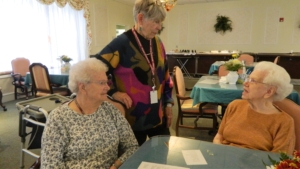
Homeland Center Board of Managers Chair Susan Batista, center, discusses upcoming events and plans for activities with residents Betty Wise, left, and Fay Dunkle.

At Homeland Center, the unique Board of Managers assures the little things that make life pleasurable for residents, and now, the board is modernizing to enhance Homeland’s home-like feel.

The Board of Managers is a separate entity from the traditional Board of Trustees. While the Board of Trustees keeps Homeland running smoothly by overseeing fiscal and operational duties, the Board of Managers handles interior details and many day-to-day functions. They include selecting furniture and décor, hosting events, and sponsoring activities such as the visit by a food truck delivering hot, fresh French fries to delighted residents.

In 2016, with nearly 150 years of history behind it, the Board of Managers decided it was time to upgrade its by-laws, with two goals in mind – strengthening personal relationships with residents and attracting top talent by making better use of members’ time. The two goals are intertwined.

“We’re trying to have fewer actual meetings so that members can spend more time with residents,” says Board of Managers Chair Susan Batista, who led the by-laws revision.

While the Board of Managers continues with its many traditional duties, residents, family, and staff will also see signs of the changes:

  • Board of Managers members will make personal, regular visits to residents, including those who don’t get frequent visitors.
  • Board members will wear new name tags on lanyards, indicating their official association with Homeland but easier to read and recognize than small nameplates.
  • More activities such as cooking and crafts classes, led by board members sharing their interests.
  • Meet-and-greet events will introduce board members to the entire Homeland community.
  • Heightened effort to get residents’ ideas and feedback on events and activities.

“As we develop relationships with residents, we can go beyond visits where we sit and chat,” says Batista. “If residents know who we are, they might be more comfortable approaching us. They have to feel they have some say, that everything’s not decided for them.”

The by-laws revisions create a new structure that reduces the time spent on meetings. The change will help members better manage their time, as they juggle professional duties, family lives, and community causes.

The Board of Managers’ 18 members stays active and involved because “they enjoy Homeland,” says Batista. “It’s an amazing facility. The care is exemplary. It’s a hidden gem of the community that they’re proud to support.”

Board members are fortunate to work on behalf of a home where residents come first, says Batista.

“We have such a caring staff,” she says. “The staff, the Board of Managers and the Board of Trustees, and the administration are making all the difference. Everybody here is involved in every aspect of care.”

Be a part of Homeland’s commemorative cookbook!

test

Next year Homeland Center is turning 150 and we want your help making it a delicious occasion! We’re asking residents and their families, as well as employees and friends to share their favorite recipes for a special commemorative cookbook.

Recipes must be received no later than Wednesday, Nov. 30 and can be emailed to Barbara Cleeland at bcleeland@homelandcenter.org or dropped off at the Sixth Street front desk. Please make sure your recipe is clearly written and has your full name and contact information.

All money raised from the sale of the cookbook will benefit Homeland Center’s endowment fund. For more information, either email Barbara or call 717-221-7727.

Quality without compromise remains Homeland Center’s mission in a challenging new world

test

A top-to-bottom team effort has kept the 149-year-old Homeland Center at the top of its game. Wisdom, adaptability, and a “full commitment” will keep it there, leaders agreed at a recent annual meeting of the boards of Trustees and Managers.

President and CEO Barry S. Ramper II pledged that Homeland has never compromised quality and never will, despite financial pressures and a “rapidly changing” regulatory environment.

In his report to supporters and staff, President and CEO Barry S. Ramper II pledged that Homeland has never compromised quality and never will, despite financial pressures and a “rapidly changing” regulatory environment.

“I will not compromise the goal. I will not compromise the quality. I will not compromise what we have a responsibility to achieve, no matter what the environment,” Ramper vowed. “Knowing that Homeland is entrusted with all or a portion of a client’s end-of-life care, clients have and deserve an expectation of quality.”

One way Homeland is meeting today’s challenges is by expanding its services to provide a “continuum of care’’ that addresses the needs of those living at home. Homeland began expanding its services with the introduction of Homeland Hospice, which includes the region’s only dedicated pediatric hospice.

Earlier this year, Homeland unveiled two additional services to help seniors at home. Homeland HomeCare will assist seniors with daily tasks such as meal preparation and transportation, while Homeland HomeHealth will provide doctor-ordered medical assistance, ranging from providing intravenous therapy and other medications to physical therapy.

He called on everyone, including himself, to “step up their game,” even as the accolades and awards continue to build upon Homeland’s post-Civil War legacy of excellence.  The center’s achievements and reputation are reflected in five consecutive “Reader’s Choice” awards in the category of “Best Long-Term Care Facility” by the 50,000 readers of Harrisburg Magazine. Homeland is also one of the few in Central Pennsylvania to repeatedly earn Medicare’s top Five-Star rating.

“It’s harder to hold this position than to attain it,” Ramper said.

President and CEO Barry S. Ramper II, left, is joined by Board of Managers Chair Susan Batista and Board of Trustees Chair Morton Spector.

Morton Spector, chairman of the Board of Trustees, joined Ramper in saluting the staff and supporters.

“They not only accomplished this [record of achievement] with positive attitudes and unswerving devotion to our residents but also complied with the essential budget restraints without compromising the quality of care,’’ Spector said.

Soon to be faced with a new U.S. president, the continued graying of the baby boomer generation, and new government funding strategies, Spector noted that much has changed since Homeland was established in 1867. But Homeland’s commitment to quality without compromise remains steadfast, he said.

“Homeland has demonstrated that it does not falter from such challenges and does not waver from its commitment to provide the highest quality of care in the most appropriate setting possible,” Spector said.

Board of Trustees Chair Morton Spector praised Homeland’s staff for their “positive attitudes and unswerving devotion to our residents.”

In keeping with its mission to serve those who need, Homeland in the past year provided almost $3 million in charitable care. Much of this is spent to bridge the gap between the actual cost of care and shrinking public reimbursements.

To ensure that Homeland’s tradition of never asking a resident to leave because of financial reasons endures, Homeland is in the third year of its goal to increase its endowment by $20 million by the year 2020. As part of this aim, Homeland established The 1867 Society to recognize individuals and couples who have made significant, tax-deductible commitments to the endowment.

Ramper expressed his hope that more donors will join the 60 charter members of the 1867 Society featured on the Wall of Honor in the Sixth Street lobby by making a major gift, including Homeland in their estate planning, donating property or insurance, or finding another way to give more.

Ramper recalled the words of late Homeland resident, World War II veteran and Purple Heart recipient Robert D. Hanson, Esq., who told him, “One cannot just exist. One must make a difference.”

“Homeland cannot just exist. We must make a difference,” he echoed.