Fun in the sun with Homeland 2018 Summertime Fair

test
Face-painting at the fair

Face painting drew long lines of excited fair attendees.

The Homeland Summertime Fair is a blend of old traditions and new ventures, but all Maliah Sumpter wanted to do was send Homeland Center Director of Admissions and Social Services Ashley Bryan into the dunk tank.

“Because the water is cold,” she said. Maliah was among the dozens of children getting silly at the fair, Homeland’s annual thanks to the community for providing the support that makes Homeland an integral part of Harrisburg life and history.

The 2018 fair featured all the old favorites — dunk tank, bounce house, rummage sale, snow cones, French fries. Preliminary figures showed the fair raised more than $8,000 for the Homeland activities fund, which helps residents experience outings and entertainment.

Homeland’s fair also spotlighted a first-of-its-kind partnership with the Dauphin County Library System. Additionally, the library is expanding services to residents, taking books and activities into Homeland and bringing residents to the local library for programs.

DCLS brought MARCO, its mobile exploration station, to the fair. MARCO blew bubbles that floated across the parking lot transformed into fairgrounds, while kids used their imaginations to build fun structures with Straws and Connectors kits.

More residents attended the fair this year than ever before thanks to planning by Homeland’s activity staff that matched an employee with every resident who didn’t have an outside family member or friend to accompany them.

Resident Betty Dumas took a try at dunking Harrisburg Police Chief Thomas Carter into the dunk tank. Her daughter, Donna Longnaker, said she loved the entire day.

“It’s nice to see all these kids having fun,” she said. “The staff put on a nice show for the residents, and it’s wonderful.”

Chief Carter, a longtime friend of Homeland, sat in the dunk tank to honor a pledge made when employees raised $5,000 for the activities fund. His appearance drew delighted staff and children. He also told two local television reporters about Homeland’s commitment to the community and the employment opportunities it offers neighbors.
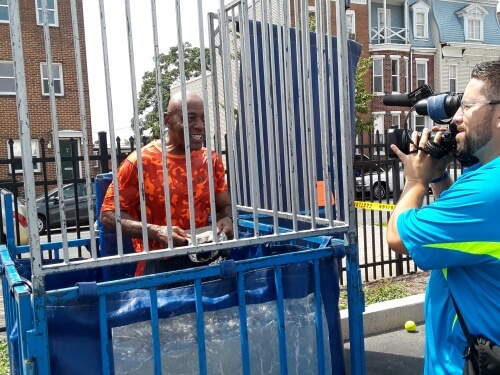
Chief Carter in the dunk tank

Harrisburg Chief of Police Carter getting dunked in support of Homeland Center.

Homeland has been “vested here,” he said. “They have been here since the Civil War days, and they plan on staying here. It’s a great working opportunity for local residents, so they are giving back.”

One little girl lining up at the dunk tank was too small to throw the ball, but Carter urged her to walk right up to the target. With a push, he plunged into the tank

“You guys want to join me?” he asked the crowd as he emerged from the water.

Nearby McLamb Memorial Church Day Care Center, which often brings children to Homeland for reading sessions and interactions with residents, brought 50 children, ages 5 to 13. Head teacher Chinia Plant said kids and staff have been “looking forward to this.”

“We get a chance to hang out with the residents,” she said. “The kids like face painting. We just like coming here for the fun.” Her student An-Nisa Ray-English, 5 years old, loved the heart she got painted on her face.

“I chose the heart, and the artist said, ‘This is a nice heart for you,’” she exulted.

Jermane Buckner appreciated Homeland’s thanks to the community. The seventh-grader from Harrisburg said his aunt lives in the neighborhood, and “all the family came out because we wanted to get out of the house together. Everything is fun.”

At the sun protection station, Homeland Hospice staffers Bethany Traxler and Eva Nicotera were distributing sunglasses and sunscreen.

“People can come out and see what Homeland does, not only for the residents but for the community,” Traxler said.

At the rummage sale, run by the Homeland Board of Managers, shoppers perused housewares, collectibles, and $1 jewelry. Staffing the tables, Joyce Thomas said she followed in her mother-in-law’s footsteps onto the Board of Managers.

“Everybody has a home here,” she said. “It’s a very relaxed atmosphere.”

Residents enjoying the fair included Elaine Golembiewski.

“It’s a beautiful day,” she said. “Everything’s good. We’re outside. What more could you want?”

Her son, Steve Golembiewski, appreciated the care his mother receives.

“Homeland is really top-notch,” he said. “Everyone seems immersed in their jobs, and they care about the residents.”
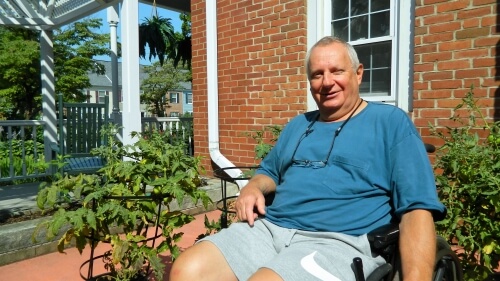
Homeland resident Carl Barna makes his garden grow

test
Carl Barna

Homeland resident Carl Barna enjoying the tomato-plant garden.

Carl Barna is giving a tour of the impromptu tomato garden sprouting on the veranda overlooking Homeland Center’s verdant Catherine Elizabeth Meikle Courtyard.

“There’s Bush Goliath,” he says, rattling off the varieties growing in pots. “Then there’s Celebrity. There’s a Roma. There’s one called a Patio tomato.”

Where Carl Barna goes, there’s a project going on. He has spent a lifetime building decks and porches, fixing up homes, cooking, sewing and upholstering, and growing vegetable gardens, especially those featuring his favorite – spicy-hot jalapeno peppers. At Homeland, he pitches in wherever there’s a need and, with his outgoing nature, strikes up conversations with everyone.

Homeland’s little vegetable garden started late this summer, when Carl acquired the tomato plants, plus jalapeno and red bell peppers now growing in a stone planter, from obliging home store managers, happy to see their end-of-season plants going to Homeland Center.

He has thoughts about expanding the garden in future seasons. He could build raised planters for vegetables, and maybe grow fresh herbs for the Homeland kitchens.

Carl is a Harrisburg native, growing up a middle son in a family of four girls and five boys. He played baseball and football. He camped and roamed the woods above his home. By age 13 or so, he was working, carting concrete around building sites for the father of television producer and Harrisburg native Carmen Finestra.

He always knew he didn’t want to work in an office. He graduated from Bishop McDevitt High School in 1972, just as Tropical Storm Agnes was devastating Harrisburg, so he found work clearing mud and debris from flooded stores. Then, Carl found work as a Penn Central Railroad brakeman. It was hazardous work, jumping on cars being separated and classified for the next leg of their journeys. If they were boxcars, he would climb to the roof. At the Enola railyard, his job was to tie the handbrakes to stop each car before they ran out of track. Once a group was secured, another batch of cars might come over the hump, to be stopped by the cars already tied down.

After four years with the railroad, a car crash left Carl with limited use of his legs, but he stayed busy. He worked in real estate, fixing up houses and even erecting a modular home for his mother. Today, he maintains his powerful build by attending Homeland’s exercise classes. Every morning, he does 150 sit-ups and 1,500 reps of a twist with a cane threaded behind his shoulders.

All his life, Carl has learned by doing and by picking the brains of others. He learned to cook from the TV chefs he would watch with his mother. There were the little tricks that made cooking easier, such as using a mustard bottle to squeeze out precise drops of olive oil. He came to appreciate the results of cooking with cast-iron pans, producing broiled pork chops that came out as well as grilled.

Carl brings a cheery attitude to every activity and meal at Homeland, perhaps coaxing a laugh and a little chair dance from someone in an exercise class, or helping a skilled-care resident fill out a bingo card. When he goes to bingo, everyone leaves with a prize. It’s all part of his philosophy to make someone’s day, every day.

“I have fun with everybody,” he says.

Homeland residents serve as subjects for portrait project and exhibit

test
Homeland portrait project

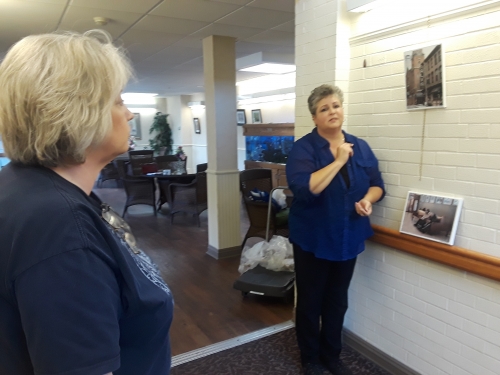
Mindy Deardorff (seated) and Sherryl Heberlig working on the details for their portrait project at Homeland.

When Mindy Deardorff doodles, she doodles faces.

“I love faces,” says the artist. “I’ve drawn faces since I was a kid.”

She especially enjoys drawing the faces of the elderly. “There’s more character,” she says. “There’s more wisdom. You get more from the expressions.”

With her love for drawing faces, Deardorff collaborated with photographer Sherryl Heberlig on a unique project for the quarterly Homeland Center art exhibit. Heberlig took photos of a few, willing Homeland residents. Deardorff sketched their portraits in graphite, and each subject received a print of the picture.

The exhibit, which also includes paintings by Deardorff and scenic photos by Heberlig, is part of the rotating series mounted by artists from the Art Association of Harrisburg. The artwork hangs in Homeland Center’s Florida Room and gallery.

Heberlig and Deardorff are longtime friends who have partnered on previous projects. When Heberlig saw a notice about exhibiting at Homeland, she pitched the idea and found a receptive audience.

“Mindy likes to draw realistic portraits,” said Heberlig. “I said that maybe we could take pictures of some of the residents and give them a photograph for their families or themselves, and Mindy could draw them and have a drawing for her portfolio.”

On a warm day in June, four Homeland residents got ready for their close-ups. They included Geoffrey Davenport, who had his portrait taken in the Catherine Elizabeth Meikle Courtyard, as water splashed over the fountain and birds sang amid the blooming flowers and trees. Heberlig made him feel comfortable by joking as her camera shutter clicked.

“Can you look out like you’re looking at a pretty girl?” she asked.

Homeland portrait project

Homeland resident Geoffrey Davenport in the 5th Street Garden, with the Catherine Elizabeth Meikle courtyard as the backdrop.

Mr. Davenport readily complied.

“I want to do this because it’s part of Homeland, and I like Homeland,” he said. “I like the artwork in the gallery.”

As Heberlig snapped photos, Deardorff reviewed the images, looking for “nice strong features and expressions. Good shadows, but not too harsh. Something relaxed. Not too tight.” Mr. Davenport, she said, “looks very relaxed.”

Even as a child, Heberlig was always taking pictures of people. For Christmas, her parents would give her flashcubes packaged in tall rolls. Today, helping her subjects loosen up gets Heberlig the candid photos she likes.

“When people relax a little bit – boom, that’s when I get the photo,” she said.

On the day Heberlig and Deardorff were hanging their exhibit, they found another subject. Resident Mildred Anthony and her daughter, Jean Dyszel, learned about the project when they were walking past. Dyszel said that her mother had a pencil sketch done at 5 years old, so arrangements were made to schedule a photo shoot and get a new drawing.

A copy of the original sketch now hangs in Mrs. Anthony’s room at Homeland – a little girl with dark hair styled in a 1930s bob. She remembers exactly how it happened, when an artist came to the house with a painting of Jesus at Gethsemane that he had painted for her mother.

“While he was there, my mother told me to wash my face,” Mrs. Anthony said. “Isn’t that a nice sketch? He was a very talented man.”

Her daughter loved the symmetry of pairing the new portrait with the older one. “It’s lovely,” she said. “It’ll create another memory.”

The exhibit included paintings Deardorff modeled after “scads of pictures” she found at an uncle’s house. All were small snapshots in black-and-white, going back decades. One depicted a young girl, but Deardorff doesn’t know who she was.

“My uncle didn’t label anything,” she said. “All I know is that it’s a relative.”

As for exhibiting at Homeland, the artists loved the opportunity to share their work with residents and staff. Deardorff, whose father was a patient of Homeland Hospice in 2017, noticed the colorful, 1950s-style diner.

“Homeland is tucked away so nice and neat,” she said. “I love the little diner.”

Homeland portrait project

Sherryl Heberlig and Mindy Deardorff finalizing the latest Homeland Center art exhibit.

Heberlig’s exhibit entries included her photos of Harrisburg landmarks, printed on canvas and treated with a gel medium in a labor-intensive process that makes the picture look old and distressed. The buildings included the Alva Restaurant, the Harrisburg train station, and the legendary Subway Café.

Resident Nancy Hess immediately recognized the local scenes. The photo of the Harrisburg train station, which dates to 1887 and is on the National Register of Historic Places, instantly brought back memories. During World War II, she remembered, the USO would hold dances in the station’s expansive lobby with coffered ceiling.

“That was fun,” she said. “My friends and I would go down there and dance.”

Resident Spotlight: Mildred Anthony’s dad made records while her mom made moonshine

test
Mildred Anthony

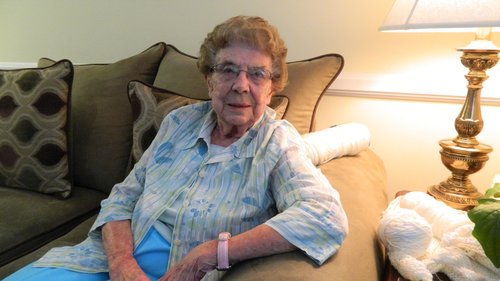
Mildred Anthony, settling in to enjoy living at Homeland Center.

When Mildred Anthony was a child, Sunday dinner was an early affair. Afterward, her father would get into his 1935 Hudson and drive the members of his band, the Mahanoy City Eagles Band, to New York City.

After midnight, Mildred’s family would gather around the radio to hear her father’s band play a broadcast.

“It was thrilling to listen to,” recalls Mildred from her cheery Homeland personal care suite. “I was thrilled.”

Mildred’s father, John Wichalonis, was a trumpeter and first-generation Lithuanian-American who made the first recordings of Lithuanian music in the U.S., for Columbia Records. His father, Mildred’s grandfather, could play any instrument, and he taught his son traditional Lithuanian tunes. Her father, in turn, transcribed the tunes into sheet music.

The recording and broadcasting gigs started in the 1930s from their home in the Pennsylvania anthracite region town of Mahanoy City.

“He was playing around the area at different dances, and the record company contacted him,” Mildred says. “They gave us a record and a record player. If you didn’t wind it up, the records would slow down.”

While Mildred’s father was busy as a coal mine fire boss, plus his music sideline, her mother, Julia, had her own entrepreneurial streak – operating a liquor still in the basement.

During Prohibition, the brewery nearby would alert her to pending raids by government agents, and she would burn incense to cover the fermentation smell. Julia’s boilo – an anthracite-region tradition made with whiskey, berries, and caraway seed – sold in five-gallon quantities.

“It’s like a demitasse,” Mildred says. “You’re supposed to sip it, but at the weddings, they drank it down.”

As a little girl, Mildred would watch tap-dance classes through the window of a dance school and when she convinced her mother to let her take lessons, she already knew the first steps. Soon, she was tap dancing like Shirley Temple and performing at local minstrel shows. Even years later, she could break out a few steps for the Frackville Women’s Club.

For 12 years, Mildred managed a bank branch in Frackville, PA. She loved her work, assuring attentive service for every customer. One couple approached the bank next door for a mortgage but ended up with her bank after meeting her.

“I loved working with people and helping them,” she says. “You have to be friendly with people and have their confidence.”

On the wall of Mildred’s room hangs a 1948 photo of her husband Tom beside his Indian motorcycle. The couple met at a dance where Mildred’s father was playing. They married a year later.

“My dad used to take me to the dances, and then I met Tom, and I didn’t go home with my dad anymore,” she says. “I went with him. I loved him. He was so nice and humble.”

Tom’s Lebanese roots were so deep that he had more family in Beirut and its countryside than in the U.S. When they traveled there, Mildred witnessed the beauty of Lebanon, including snow-capped mountains and the fabled tall cedars.

Mildred and Tom were married for 68 years, until his passing in June 2018. They lived in Frackville, where he was a meat cutter for Acme markets. They raised a son and a daughter she calls “the best gift in my life.” The family enjoyed outdoor adventures and water sports from their cabin at a lake near Jim Thorpe, Pennsylvania.

At Homeland, Mildred’s suite, filled with natural light from two large windows, is cleverly laid out. A sofa bed accommodates overnight guests. A long bench serves as a coffee table, and a drop-leaf table nestling at the foot of the bed provides a handy spot for sitting with visitors.

Mildred came to Homeland in 2017 for skilled care and made so much progress that she moved into personal care.

“I got good care,” she says. “I came a long way from the time I came here.”

She enjoys Homeland’s musical programs, especially the visit earlier this year by ragtime pianist Domingo Mancuello.

Today, Mildred looks back on a full life.

“I’m blessed,” she says. “I’ve had a happy life. There are always bumps in the road, but I thank God for what I have today.”

Homeland CNA Anita Payne brings a light and loving heart to her work

test
Anita Payne

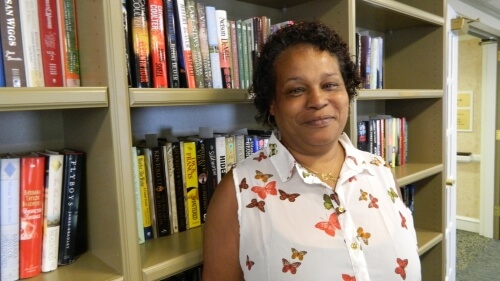
Anita Payne, grateful to be working with Homeland Center residents in numerous roles for 13 years.

Anita Payne knows what makes a good CNA.

“A true heart,” she said. “Honesty. Patience. And being willing to learn, because nursing is forever changing. People can’t come into this thinking they know everything.”

Anita has been with Homeland Center since 2005, and she is “truly grateful” for those 13 years and counting. She moved to Harrisburg from her native Pittsburgh to get a better education for her daughter. Once here, she persevered to get an interview with Homeland because everyone told her, “It’s hard to get in, but it’ll be the best place to work.”

Since coming to Homeland, she has worked in skilled care, activities, and now in personal care, where she hopes to stay until her retirement.

“It has the proper name because it is so personal,” she said. “Our staff gets along so well. It’s like one big, happy family.”

Anita grew up helping elderly neighbors, whether it was going to the store for them or shoveling snow. “You’re giving so much happiness to people,” she said. “It means a lot to make sure they’re lighthearted and smiling and never need anything.”

She once heard someone say that CNAs needed to “think outside the box.” She pondered that phrase for a long time until she realized that it meant her duties are “whatever the residents need.” One resident had always worked with his hands and needed to be active. She thought about it and approached Esther Burnside, administrative assistant to Homeland President and CEO Barry Ramper II. Could the resident deliver mail? It’s a duty he now performs faithfully.

“We brought him a postal hat,” said Anita. “He got his Homeland volunteer badge. Esther gets the mail ready. He comes into the Olewine Gathering Room and sorts it and puts the room numbers on it, and he delivers it. It’s a team effort. I thought of something for him to do, and Esther helped make it happen. And he loves it.”

At one training session, Ramper gave the CNAs a small mirror, and Anita came to realize it wasn’t for her reflection.

“It was for the reflection the residents see of me. It’s very important to me that the residents are very comfortable with me, and that they have light hearts. I want to be honest with them. I want to communicate. I want them to feel like they can tell me anything.”

Anita loves her 2 p.m. to 10 p.m. shift, sharing the day with residents and getting to know their families. Outside of work, she enjoys going to movies and socializing with friends. She and her 29-year-old daughter enjoy a tight bond, telling each other everything.

She has worked in other care settings – one in Pittsburgh where standards were high, but another in central Pennsylvania where she worked two weeks before leaving, unable to tolerate the lax care. Treating residents with respect is essential, she said.

“All of us at Homeland understand that caring for our residents is our most important duty and I know from top to bottom, everyone is trying to do their best for the residents,’’ she said. “I’m proud to be part of Homeland Center, and I’m grateful.”

Christmas spirit is a lifetime tradition for Homeland resident Marie Andrews

test
Marie Andrews

Homeland resident, Marie Andrews, relaxing in her suite.

In 1934, Marie Andrews’ father started a tradition in Lykens, Pennsylvania, that continues to this day.

To thank the customers of his hardware store and electrical appliance repair shop, Richard Klinger outfitted a sound truck with evergreens, sat on top wearing a Santa Claus suit, and drove through the town, distributing candy and oranges to children.

In the years to come, the truck would be “electrically decorated,” in the words of one newspaper account, and tour the towns of northern Dauphin County. For more than 75 years, three generations of the Klinger family kept the tradition alive, and it continues today with their support and under the auspices of Lykens Borough. Cowboy singer Gene Autry even sent Marie’s dad a thank-you letter for featuring his recording “Here Comes Santa Claus.”

“It’s still called ‘Klinger’s Float,’ and it still goes out on Christmas Eve,” Marie said. The annual event took a lot of work on the family’s part. Marie remembers the first year when she bagged peanuts to be handed out.

Graduating from high school in 1943, she learned of a wartime program paying for nurses’ training. Harrisburg would have been close, but she figured if she could go anyplace for the training, why not try Philadelphia?

“I don’t know how I had the guts to do it,” she said. First, she applied at a Philadelphia hospital where a friend was studying. When that program accepted her right away, she thought, “If they would take me without even knowing me, maybe Penn would take me.”

She had to pass a lot of tests, but she made it into the University of Pennsylvania. It was an excellent program, with thorough training and strict standards. By the time she graduated, the war was over. Back in central Pennsylvania, she married and had her sons.

Marie worked at several jobs until becoming a school nurse in Central Dauphin School District, outside of Harrisburg, where she stayed for 28 years.

“I liked being with the kids,” she said. “It was an interesting job. There were lots of nice people to work with.”

Her sons attended Central Dauphin schools and, apparently inheriting their grandfather’s handyman genes, studied engineering in college. They both live in the Harrisburg area, and Marie now has four grandchildren, two great-grandchildren, and a third on the way.

From her cheery personal care suite at Homeland, Marie likes to knit. Family members receive gifts such as a stocking cap in Philadelphia Eagles green and white, or a receiving blanket for the new baby.

She has lived happily at Homeland since 2012. She enjoys volunteering in Homeland’s library, as well as taking exercise classes and attending music events. From her window, she watches birds in the trees, including a cardinal that sometimes shows up.

“We do a lot of nice things,” she said. “I go on the shopping trips. I do well. I have a lot of friends. I’m very comfortable here.”