Board of Managers member Beth Stoner brings splashes of color to Homeland

test
Beth Stoner

Beth Stoner, member of the Board of Managers at Homeland Center.

Beth Stoner loves to paint flowers, and though her artwork isn’t on display at Homeland, her artistry is on view in another sense. At the entrances to Homeland are colorful planters that Beth helped create. Brimming with flowers, they extend a cheery welcome to residents and visitors alike.

Homeland has a unique system of dual boards that combine to assure a well-run, comfortable facility. The Board of Directors oversees policies and finances, while the Board of Managers enlivens Homeland’s atmosphere with home-like décor and fun activities.

Beth has served on the Board of Managers since August 2018. Growing up, Beth’s parents instilled in her a love of art, music, and history. Classical music recordings were always playing in her home. Her father would stand in front of the hi-fi and pretend to conduct the orchestra – once, even using a conductor’s baton that came with a record.

Beth’s father also took the family to see battlefields in Gettysburg and artwork at the Philadelphia Art Museum, but his professional career followed a more technical path that culminated in his post as executive director of the Pennsylvania Turnpike. During World War II, he worked on the Manhattan Project, the U.S. government’s hush-hush initiative to develop an atom bomb.

“It was all secret, secret, secret,” Beth says. “When the first bomb was dropped, all the wives came out of their homes and wondered if this was what they were there for.”

Beth graduated from Camp Hill High School and then attended Alderson Broadus College – now Alderson Broadus University – in the “little, teeny town of Philippi, West Virginia.” There, she majored in history and minored in sociology and psychology. She spent a semester in Salzburg, Austria, where she had great fun “wandering the city” and exploring Vienna, Italy, and Czechoslovakia.

It’s a habit she continues, with travels that now include England, Ireland, Scotland, and Wales. She cruised the Baltic last year, but high winds kept her ship in St. Petersburg an extra day, so she didn’t get to disembark in Gdansk.

After graduating from college, Beth returned home and resumed something she had always loved – singing in a church choir. There, she met her future husband, Bill. Within a few years, his health started declining, and he needed dialysis. Beth was learning to operate an in-home dialysis machine, but the day it was supposed to arrive, a call came from Johns Hopkins University in Baltimore. They had a kidney for him, and he underwent a transplant in January 1977.

“That transplant gave us 14 more years,” she says. Bill’s career took them to New Jersey, Indiana, and Michigan, but as his health deteriorated further, they returned to central Pennsylvania to be close to family. The harsh anti-rejection medications transplant recipients needed in those days eventually took their toll, and Bill died in 1992.

Although much of her time had been devoted to helping care for Bill and accompanying him to regular medical appointments, Beth also worked in various administrative jobs over the years. After he died, she supervised Delta Dental typists for 14 years.

Beth remarried through an improbable series of connections. Her late husband’s former wife, with whom she was always friendly, thought Beth should meet her friend Max Stoner. Then Beth’s next-door neighbor – by coincidence, good friends with the parents of the same Max Stoner – said the same thing. That’s when Beth decided it was time. They met, and they married in 2007.

Max is an environmental engineer, and as the owner of Glace Associates, works with municipalities to develop water systems. Beth still sings and is a member of Market Square Presbyterian Church’s choir. She has two stepsons, two stepdaughters, and four grandchildren.

At Homeland, Beth creates spring and fall plantings, helps set up for activities and serves on the long-range planning and house and grounds committees. Homeland is a good fit for her because she has always loved being around the elderly. Her work helps maintain Homeland’s friendly atmosphere, and that’s gratifying.

“It helps the residents who live here feel more at home,” she says. “It also makes a good impression. It’s very important that the people who come here to visit see a place that’s cheery and pleasant. Homeland is a great place.”
Never forget: Homeland Center notes Holocaust Remembrance Day

test
Holocaust Remembrance Day

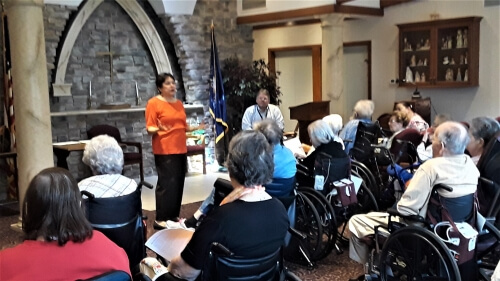
Lillian Rappaport, daughter of Holocaust survivors, shares their story with resident’s at Homeland Center.

At age 20, Lillian Rappaport’s parents hadn’t met yet. Both were living poor but normal lives in the Warsaw-area Jewish villages called shtetls. It all changed in September 1939 when the Nazis invaded Poland, the start of the Second World War.

“Neighbor turned against neighbor,” Holocaust educator Rappaport told Homeland Center residents. “People they were friendly with, people they went to school with, people they socialized with, all of a sudden turned their backs on them, and not just turned their backs but sometimes did more terrible things to them.”

Homeland Center hosted a well-attended Holocaust Remembrance Day program in the Homeland Chapel in early May. The event, part of a Homeland series on the Lessons of Jewish history, reflected global recognition of Holocaust Remembrance Day. The day amplified the voices of survivors and their descendants to ensure that the world never forgets or repeats the time in history when 6 million Jews and 5 million other “undesirables” were systematically slaughtered.

Holocaust Remembrance Day

Lillian Rappaport answers questions following her presentation.

“Here at Homeland Center, we surely believe that all of us regardless of our age need to remember,” program organizer and Homeland Hospice Chaplain Dann Caldwell said. Recent synagogue shootings spotlight the need for vigilance against anti-Semitic feelings and expressions that spiral into violence, Caldwell said.

“We need to consider things from our moral, ethical, and historical perspectives,’’ he said. “We need to engage with these issues, to learn again, to never forget, to work as one people to make sure these horrors do not happen again.”

The Holocaust started with small actions in Germany, “the most sophisticated, enlightened country in Europe,” said Rappaport. Germany’s 500,000 Jews and others, including Roma people and the disabled, were “marginalized and excluded.”

But with the invasion of Poland, the Jewish population under control grew by 3.3 million, and the German hierarchy under Adolph Hitler devised a plan of extermination. Within months, Rappaport’s parents were sent to a Nazi ghetto, where entire families were forced to live in single rooms, and starvation and brutality became the norm.

Rappaport’s mother, Genia, plus four siblings and a brother-in-law, were transported to concentration and slave labor camps, but all survived. Family legend says that Genia’s mother knew that God would protect her family because of her devotion to tzedakah, the Jewish concept of giving even if one has almost nothing of one’s own.

“They all weighed about 50 pounds when they were liberated,” Rappaport told the rapt audience. “They survived. Their bodies healed, and they all went on to live good, productive lives.”

Her father, Jacob Weinstock, endured all the horrors of the Holocaust, and as a result, “his soul was injured.” He survived by luck, wits, and talent. By tailoring beautiful uniforms for officers in slave labor camps, he would be rewarded with an extra piece of bread or a potato – the difference between survival and starvation.

As Allied troops were approaching to liberate Buchenwald, Jacob hid in the mud under his barracks for days while guards were killing prisoners in an attempt to silence witnesses. When he finally emerged, the sight of the first black man he ever saw – an African American GI – told him he was free.

He would learn that he was the sole survivor of his family. “No parents, siblings, aunts, uncles, cousins remained,” Rappaport said. All had perished in the camps, or died from starvation days after liberation, or been murdered by Poles.

Jacob and Genia met in a displaced person’s camp. They married, had their first baby, and in 1949, were among about 30 refugee families brought to the U.S. by Harrisburg’s Jewish community. Lillian was born the next year. Jacob opened a tailor shop, known to customers as a jovial and talented businessman.

While Jacob rarely talked about his Holocaust memories, Rappaport knew that it “never left my father’s soul.” On her wedding day, as her parents walked her down the aisle, Rappaport realized her father was crying.

“Look at all the people who aren’t here,” he said.

Today, Rappaport is religious school principal for Temple Ohev Sholom, Harrisburg, and Holocaust educator for the Jewish Federation of Greater Harrisburg. She has completed special training in Holocaust education at Yad Vashem Holocaust Institute in Jerusalem.

Homeland resident Pat Myers called the program “very informative. Vey heart-wrenching.” The Holocaust “teaches us an awful lesson,” she said, but Rappaport “has it right on the button. Somebody’s got to tell the story. We all have to think of each other.”

The ‘collective heart’ of Homeland volunteers gives time and passion

test
Barry Ramper and Gloria Mineur

Barry Ramper, CEO and Gloria Minuer, volunteer enjoy the program together.

The volunteers of Homeland share more than their time. They also share life lessons in generosity, giving, and selflessness.

“For you to take the time you take to serve the best interest of our patients, residents, and clients – sincerely, I thank you from the bottom of my heart,” Homeland Center President and CEO Barry Ramper II said during the annual celebration of all things volunteering.

Volunteers provide essential support for Homeland Center and Homeland Hospice, offering companionship to residents and patients, and administrative help to office staff. At the thank-you dinner, Homeland’s culinary staff served a meal of grilled chicken breast, fresh asparagus, rosemary roasted red potatoes, and tempting desserts.

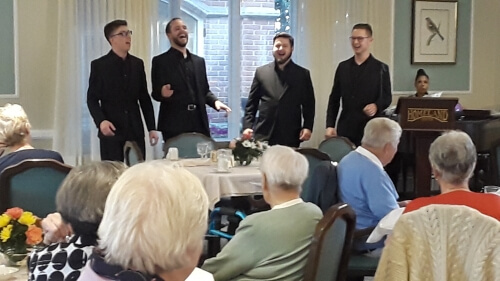
Held in the Main Dining Room, bouquets of daisies and carnations adorned the tables, and walls and windows flaunted crisp new décor – flowers and redecorating all done by Homeland Center’s unique, volunteer Board of Managers. The program started with selections sung by Brothers in Arms, a young a cappella quartet sharingexpertly performed barbershop standards.

The ‘collective heart’ of Homeland volunteersEach volunteer received a small herb planter, an appropriate memento of the seeds of volunteerism that blossom into inspiration. Those honored for the most hours logged and for longevity, plus the dedicated spirit they gave to Homeland Center, over the last year were:
• Barbara Pak, 165 hours, who visits residents and helps with lunch duties.
• Judie Marcus, 304 hours, including 276 hours working in Homeland Center’s gift shop and 28 hours for Homeland Hospice, where she helps clients stay engaged.
• Lee Jackson, 187 hours supporting the Homeland Hospice bereavement program, plus additional hours decorating holiday trees and preparing hors-d’oeuvres for an event.
• Ann Phillips, 122 hours supporting the Homeland Hospice bereavement program and Homeland Hospice 5K and Memory Walk.
• Longevity: Gloria Minuer, 19 years.

Good friends Doris Coyne and Flora Jespersen were recognized posthumously for their 20 years of volunteer service by Homeland Activities Director and Volunteer Coordinator Gillian Sumpter. They are, Sumpter hopes, “playing bridge and taking charge in heaven.”

Sumpter also presented a clock to the daughters of the late Herm Minkoff, host of Homeland’s popular Sports Talk with Herm. His lively, bi-weekly gathering covered not just athletics but their meaning in society and sometimes the controversies that come with them.

“My father loved this place,” said Herm’s daughter Sheri Solomon. “For days, he would put his discussions together, and he would be so excited. After our mother passed away four years ago, Homeland became a significant place for him. Thank you all so very much for letting him have the joy of Homeland every other Thursday.”

Homeland Hospice Coordinator of Volunteers Laurie Murry thanked all the volunteers for their dedication.

“When you give away an hour, it’s gone. It can’t be copied. It can’t be duplicated or regulated,” Murry said. “We would be poorer if we didn’t remember that the giving of your time is the richest thing you can do.”

After the ceremony, longtime volunteer Gloria Minuer said she always enjoyed directing engaging activities such as You Be the Judge, where residents heard the details of actual court cases, passed judgment, and then learned how juries ruled.

“I don’t think there’s any other place like Homeland,” she said. “They do their best to keep everything on the highest level possible.”

Lee Jackson and Laurie Murry

Lee Jackson, Hospice volunteer and Laurie Murray, Coordinator of Volunteers for Homeland Hospice

Volunteer Lee Jackson said he feels gratification for doing work at which he excels. He has learned to appreciate the behind-the-scenes work needed to maintain excellence at Homeland Hospice. “Working in the office and seeing what they do is pretty amazing,” he said.

Ramper closed the night by telling guests that Minkoff, who regularly posted 5K times that beat much younger runners, will leave behind a legacy of motivation that will inspire him “for the rest of my life.”

Homeland could not have maintained the highest-level quality of care for 152 years without “a strong, committed volunteer group that supported, assisted, gave counsel, gave guidance, and supports development efforts.”

“It’s not about the number of people involved,” Ramper said. “It’s how committed the hearts are of the people who are involved. The most important thing in this room is a collective heart that is unsurpassed.”

Julie Riker’s open-air paintings bring beautiful scenery to Homeland

test
Julie Riker's paintings

Homeland’s art Gallery featuring Julie Riker’s pieces

Step into the Homeland Center art gallery, and the outdoors await. Feel the breeze from the river. Refresh in the coolness of a stone stable. Breathe in the perfume of the lilies.

The spring 2019 exhibit from guest artist Julie Riker features works capturing the fleeting nature of nature herself. Done in the open-air style known as plein air, many reveal fresh perspectives on verdant scenes, as seen through Julie’s eyes.

Julie calls herself “an observational painter.” Whether painting outdoors or inside, she prefers “standing in front of what I’m painting, as opposed to painting from a photograph or making it up out of my head.”

“I like to respond to the place or whatever it is I’m looking at,” she says. “I don’t try to make the painting exactly like it. I have a bit of impressionist style, but I’m trying to be truthful to the colors and values that I’m seeing.”

Julie is the current artist featured in Homeland’s Florida Room gallery. Every quarter, the Art Association of Harrisburg offers an exhibit from a member artist, chosen through a unique program that puts the works of local artists in offices and lobbies throughout the region. Homeland, the only retirement community in the program, hangs the works in the hallway gallery near the Olewine Diner for residents, staff, and guests to enjoy.

Julie discovered her love for art as a child. After graduating from Cumberland Valley High School, she attended the Philadelphia College of Art – now the University of the Arts – as an illustration major. Her first job out of school landed her in the Pennsylvania Capitol, with a company restoring the landmark building’s spectacular Art Nouveau décor. The work involved meticulous cleaning of long-neglected artworks on walls and even ceilings, often done while lying on scaffolding and dabbing at paintings with cotton balls.

“I learned how to do a lot of the gold leaf,” she says. “I went from doing little pictures to doing largescale walls.”

She left that job to start her own business creating faux finishes and murals for private homes and businesses (www.julieriker.com). The springtime exhibit at Homeland was not Julie’s first connection here. She first helped brighten Homeland’s halls by painting a sky on the ceiling of the solarium.

Julie also has taught art groups in the region, including basic drawing classes.

“Drawing skills are so essential for painting,” she says. “If you look at my paintings, the foundation is a solid drawing.”

Julie Riker

Artist Julie Riker enjoying the very definition of the plein air style of painting

Julie’s travels often take her to plein air competitions across the country, where she is an invited or juried artist with several awards to her name. She enjoys a challenge, whether it’s working outside in bad weather or responding to light that changes every 15 minutes during a plein air session.

“You have to work quickly to capture the light,” she says. “You have to establish where the light’s coming from and the shapes of the shadows, because that’s going to change quickly.”

Recently, Julie established a studio, within walking distance of her Camp Hill home that will give her the option to offer classes, she says.

She hopes that getting her paintings out of the studio and into Homeland’s halls helps brighten the day of a viewer or two.

“If someone can think of me and enjoy passing them, that’s a good thing,” she says. “I hope people enjoy looking at the paintings.

Mother and son make Homeland their home

test
Peggy and Rusty Keiser

Peggy and Russell (aka Rusty) Kreiser at Homeland Center

Over the years, Homeland has seen many residents who are husband and wife. There have been siblings, too.

But a mother and son? That is a first since Peggy and Russell Keiser have made Homeland their happy home.

Peggy and Rusty, as he’s known to all, arrived in late 2018. She is well-known in the area for her 65 years as the secretary for 10 superintendents of Susquehanna Township School District, from Joseph Hilbush in 1943 to Susan Kegerise in 2011.

Along the way, her accumulated “claim to fame’’ as she calls it, included:

  • Creation of an annual scholarship known as the Peggy Hummel Keiser Scholarship for the Secretarial Sciences, established in 1991 by the Susquehanna Township High School class of 1951.
  • Renaming of the high school library to the Keiser-Fearen Library Media Center, in honor of her and “a treasure of a teacher” named Alice Fearen.
  • And on her retirement, more years of service in the Pennsylvania School Employees’ Retirement System than anyone else – ever.

Peggy’s storied career started because she and three other Susquehanna Township High School seniors, all girls, were asked to help with secretarial work in the office. Before graduation, she was asked to take the position full-time. That began 65 years of knowing the school district inside and out and watching it grow.

Peggy’s Central Pennsylvania roots run deep. Her maiden name of Hummel marks her as a descendant of the founder of the Hershey-area town of Hummelstown. Plus, her mother was a Lingle, connected to the founding of the charming Harrisburg-area village of Linglestown.

Peggy’s father worked in the office of Harrisburg Steel. By the time Peggy retired, she was back living in the Susquehanna Township home built brick-by-brick by her grandfather, Augustus Alitto. An immigrant from Calabria, Italy, Alitto was one of the stone masons who worked on the Susquehanna Township School District elementary school and the Hersheypark Arena, the original home of the AHL Hershey Bears.

Soon after she started working for the school district, young Peggy was selling tickets at a football game, when she accidentally shortchanged a sailor named Nelson Keiser. They were married the next year and had two children, Sandra and Rusty.

The children attended Susquehanna Township schools, where Sandy was involved in field hockey. Rusty was a special education student who loved sports so much that he got to work with legendary football coach Roscoe Warner.

In 1979, Peggy was thinking about retiring, but one day, her husband called to say he wasn’t feeling well. She took him to the hospital, where he later died. Although it was a difficult time for her, she persevered. Peggy and Nelson had lived in a beautiful home in Susquehanna Township, but it became too much to manage, so she moved into the brick cottage that her grandfather built.

Today Rusty still loves sports, especially the Philadelphia Phillies. He has met the late, great announcer Harry Kalas. He roots for the team through thick and thin.

“They lost last night 15 to 1,” he said the day after a trouncing by the rival Washington Nationals. “But I just like to watch them play.”

Added Peggy, “He’s terrible when he’s watching them. He’s terribly loud.”

The move to Homeland has gone very well for mother and son. When Peggy felt it was time to leave her home, they decided to get a suite for each of them. Their apartments, including Peggy’s bright corner room, are two doors away from each other.

“He knows everybody here,’’ said Peggy. “He loves this place.”

Rusty takes advantage of the full range of activities available. “Bingo,” he said. “Sports trivia. Exercises. I do exercises six days a week.”

She, too, enjoys Homeland, attending holiday parties and special events.

“The people are nice,” she said. “It’s a place of pleasure and convenience. I like it here.”

Mother’s Day: Mother and daughter bring compassion and determination to Homeland operations

test
Pam Brown and Ashley Bryan

Mother and daughter, Pam and Ashley.

Residents, staff, and family often say the same thing about Homeland Center: “Everyone here is like family.”

Homeland cultivates that atmosphere through its comfortable environment, high standards, and respect for every individual.

But there’s one thing more: Homeland welcomes actual family relationships on staff. Generations of mothers, fathers, children, aunts, uncles, nieces, and nephews have devoted themselves to the care of residents.

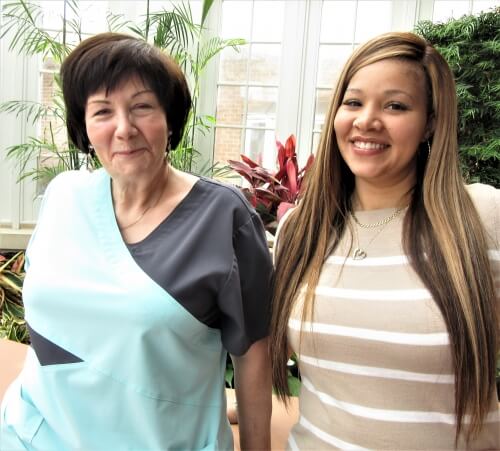
Today, they include the mother-daughter pairing of Assessment Coordinator Pamela Brown and Director of Social Services and Ellenberger Unit Coordinator Ashley Bryan. Each pursued a different professional discipline but contributes to the life of Homeland with shared joy and a commitment to excellence.

Pam was the first to join Homeland. As a girl, she knew she would be a nurse. She loved the series of books about sleuthing nurse Cherry Ames – a sort of white-capped Nancy Drew.

In her first job, she cared for cancer patients and accident victims. She saw motorcyclists who worked against all odds to recover from head injuries.

“A lot of times, they would walk out the door,” she says.

Her next job put her in a center for children with severe disabilities. Some endured seizures lacking outward manifestation, so Pam learned to watch for the signs in their eyes. Some days, she brought in Ashley to see where she worked.

“It taught me there are different people in the world,” Ashley says. “I learned about compassion.”

Pam’s work at a county nursing facility immersed her in an adventure that might have challenged even the indomitable Cherry Ames. For three of her 10 years there, she cared for men with histories of poor health and tough lives. She was “scared to death” at first but soon learned to see past their hard-bitten exteriors.

“They all just needed love and a soft touch,” she says. “You had to get beyond that initial harshness. When you learned how to work with them, they were all like little teddy bears.”

Pam joined Homeland in 2006 when she was asked to join the Data Set Documentation department responsible for insurance, billing, and the comprehensive resident assessments required by federal regulations.

“I loved what I saw,’’ she recalls of her first visit. “They had flowers everywhere and the residents’ rooms were so nice. It was a very homelike atmosphere. Everybody pulls together. Everybody truly cares about each other.”

Watching her mom at work, Ashley recognized her own desire to be “a helping professional.”

“She taught me to be caring,” Ashley says. “She taught me to be confident and go after what I wanted.”

Ashley discovered her proclivity for social work while working as a lifeguard in city housing complexes, where she might be a nurturing babysitter or the enforcer, depending on the circumstances.

While Ashley was working on her master’s degree in social work, Pam suggested that she perform her internship at Homeland. Arriving in 2011, Ashley learned how to manage caseloads in Homeland’s social services office. When Homeland offered her a full-time job, it came with the additional role of activities director. There, she strengthened fundraising capabilities, to finance an increasing array of engaging activities, and the database of community resources.

Homeland activities, she believes, have the power to enhance the quality of life, rounding out Homeland’s meticulous care that Medicare recognized with its highest rating as a CMS Five-Star Skilled Nursing Care Facility.

In July 2018, Ashley took on a new role as coordinator of Homeland’s Ellenberger Unit, for residents needing memory support.

“I love this unit,” she says. “Every single person is different; they’re unique. You can never really have a bad day on this unit.”

Pam spends her days meeting and carefully assessing new residents, catching every nuance to lay the groundwork for meeting their health needs as long as they’re at Homeland.

Ashley says her mom offers “compassion and thoroughness” to Homeland’s caring environment.

“Her job is very detail-oriented,” Ashley says. “She has to have conversations with the residents in such a way that they will give her the right information. She builds trust and compassion.”

Pam says that Ashley brings “determination.”

“She will not compromise when it comes to the well-being of the residents,” she says. “Being an advocate for residents, she will stand her ground.”

Both agree that they love working at Homeland.

“It’s been such a blessing,” says Pam, “to be able to see your child every day.”