 The Manhattan Project. The Rockettes. The Galileo spacecraft.
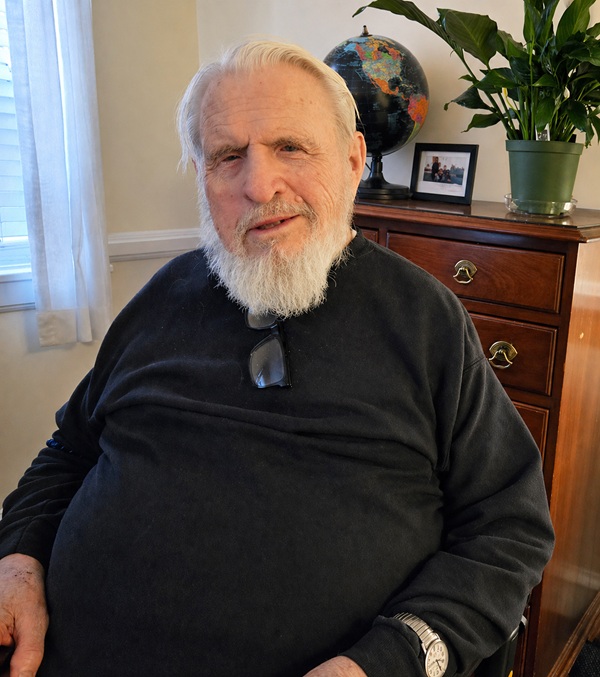
Momentous history weaves through John Daly’s story. His father was a chemical engineer for the Manhattan Project. His mother was an original Rockette. John designed the mechanics of Galileo.
John came to Homeland Center early this year and moved into a comfortable personal care suite.
“I love Homeland,” said his daughter, Elaine Daly, while visiting her dad. “I don’t worry anymore. He’s been really happy. He loves the food. The people are kind. I feel very fortunate that we found a good, safe place for him.”
When John was a child in the mid-1940s, his family lived in Paducah, KY. His father was designing and building waste pipes at Oak Ridge, Tennessee, where the government was mining uranium for the Manhattan Project, which produced the first atomic bombs.
They lived in a log cabin beside the Ohio River. The ground was too steep for kids to play, and the water came from a pump.
“The water was yellow, and even when you boiled it – we gave some to the postman, and he spat it out,” John remembers.
John’s parents met in St. Louis, their hometown. He was from a well-off family, but with his sharp intellect, he left school at age 13 and got a hands-on education in chemical engineering.
“He was a quick learner,” John said. “If he needed to know something, he would go and find out.”
John’s mother was a chorus girl, third from the end, in the Missouri Rockets. When the troupe moved to New York City and was eventually rechristened the Rockettes for the opening of Radio City Music Hall, she went along. A photo shows her living the 1920s flapper life – standing by a Model T, holding a long cigarette holder, her hair cut in a fashionable Egyptian bob.
When she went to Hollywood to dance in the chorus of a movie, John’s father followed her to a soundstage and convinced her to marry him.
“There was just a dirt road across the desert to get to California,” John said. “You had to put a big bag to carry your water in the car, because cars would overheat on the hills.”
John grew up to be a problem solver. He knew he wanted to be a mechanical engineer, and he graduated from Missouri State University.
During those college years, he met his wife, Rose, while playing chess with her brother. He couldn’t believe that none of his friends were courting this smart, beautiful woman, so he asked her out.
In those days, most mechanical engineers wrote systems specifications, but John wanted to design. He found a job in Minnesota working in a field that wasn’t glamorous – making bags for businesses, but they let him design, so he began his career doing what he loved.
“When you come out of engineering school, you become a different person,” he said. “You look at a door, and you see a vector sum. You see the forces in the door. We solve so many problems, and you get good at it.”
Eventually, he found his way to Arizona, to a NASA subcontractor. There, he designed the mechanical components for Galileo, the first “dual-spin” spacecraft, which could rotate while a section remained pointed at the stars.
It was work that families could take pride in.
“A guy I was working with said, ‘You can tell your mother about this one,’” John said.
John was also a pilot with his own planes. The first had a magneto starter, the kind that started by turning the propeller manually. The second was a Cessna 172 he flew in Arizona.
John and Rose had a son and a daughter. Rose was a special education teacher and administrator. Just as John retired, she died from colon cancer. He returned to work as a “job shopper” – a kind of consultant finding jobs where his expertise was needed for a time.
He moved to Pennsylvania to live with his daughter, Elaine, about five years ago. He came to Homeland when caring for him became more challenging, and the family couldn’t be happier.
“They’ve taken such good care of you,” Elaine said to her dad. “They take beautiful care of you.”
“They do,” John agreed. “The people are fine. The chow is good. Nice rooms.”