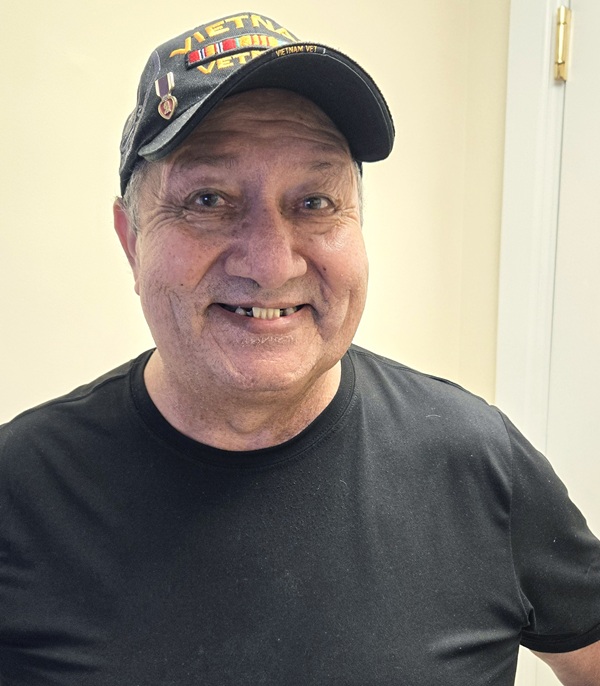
 Despite childhood deprivation, Lionel Gonzalez has a heart for giving and service.
“I never had anything as a child,” Lionel said. “I never saw happiness. I don’t know how I came to that tenderness in life, to love poetry, to love knowledge, to love the Bible – how God made me to choose the better things.”
Since coming to Homeland Center this year, he has been busy making friends, hosting visits from relatives in his comfortable personal care suite, and sharing stories from a lifetime of community leadership.
“I like it,” he said. “Some of the office people like talking to me. One described me as a genuine person.” It is, he adds with humility and the experience of hardship, “a miracle when you become likable to people.”
Lionel was born in a village in Puerto Rico. His father died when he was 1 year old. His home had no electricity, potable water, or indoor plumbing. Neighbors gave him a place to sleep. His mother cooked dinners over rocks outside and washed laundry in a creek to support her children, to the point of poisoning her hands with soap.
During childhood, he went to school barefoot. One year, all he had were pants made from rice bags and a shirt fashioned from newspaper, until a kind teacher gave him new clothes.
He didn’t know his name was Lionel until he enlisted in the Army at 20. Called Carlos or Carlitos all his life, he was stunned to learn he hadn’t even known his real name—a realization that still lingers.
“This was very strange,” he said. “When I went to Puerto Rico a few years ago, in my village, they called me Carlitos. They don’t know I’m Lionel. Can you imagine growing up in a village with the wrong name for 20 years?”
Drafted into the U.S. Army in 1968, Lionel was first sent to Fort Benning, Georgia, where the Puerto Rican draftees were ridiculed for not knowing English. Later in 1968, during the Tet Offensive, he was sent to Vietnam, where he was wounded in the leg and earned a Purple Heart.
After his discharge from the Army in 1970, Lionel enrolled at Catholic University of Puerto Rico on the GI Bill. Around the same time, he worked at a Sears store and played the trumpet – an instrument he had learned in middle and high school – with local bands.
“I love knowledge,” he said. “And I love the Bible.”
He was a philosophy professor in Puerto Rico before moving to Harrisburg to live with his sister. After taking the state Civil Service exam, he became an investigator for the Pennsylvania Public Utilities Commission, where he helped nearly 180,000 people resolve complaints and quickly restored service when ratepayers faced cutoffs for 30 years.
“What they admired was the speed I did things in two languages,” he said.
A believer in giving back, he dove into community service by volunteering at Harrisburg Hospital and serving a four-year term on the Harrisburg School Board.
“Education is not about what to think but how to think,” he said during the campaign.
He also served on the boards of the Shalom House women’s shelter and the Latino Hispanic Community Center. He wasn’t afraid to solicit donations for causes throughout the city. Whenever he arrived at Shalom House, people would say, “Well, you’d better pull your checkbook out. I think Lionel is having a meeting today.”
At Homeland, Lionel enjoys music, singing along with his rich tenor-baritone, and values the residents and staff he has met.
“They are all very friendly,” he said. “They are very nice.”
Lionel remains philosophical about his life’s path.
“I learned in life to eat with my hands and fingers, and also with a fork and a knife,” he said. “I am not the man that I want to be, but I am not the man that I used to be.”