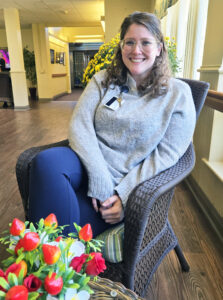
 When Liz Paulus interviewed at three nursing facilities in one day, Homeland Center’s difference was obvious.
“This was the only one where I felt very comfortable and at ease, and it didn’t smell bad,” she says, adding kudos for the hardworking housekeeping staff. “Everyone seemed very happy. No one seemed stressed. You could feel the vibe immediately. As soon as I walked in, it was very positive. When I went to the other facilities, it was chaotic.”
Liz joined Homeland in July 2025 as a social worker, helping skilled care residents live their best lives and giving family members peace of mind.
Liz studied social work, earning a bachelor’s degree in social work and psychology from the University of Maryland, Baltimore County, and a master’s degree in social work from the University of Maryland, Baltimore.
However, she brought diverse experiences to her work at Homeland. For five years, she worked in a distressed Baltimore neighborhood as a hospital emergency room registrar, where she checked in patients and confirmed their insurance. That taught her how to manage business matters with tact and compassion.
“You learn how to have the worst conversations and the most awkward conversations with people in their most vulnerable moments,” she says. “I was able to apply what I was learning in school to that. When I was taking classes on death and dying, and on inequity and healthcare policy, I was able to visualize it in real time.”
After moving to Pennsylvania to get married, she worked at a rehab facility, in a surgical unit, and overseeing Medicaid programs. The post-pandemic years took her in a new direction, when she stepped away from health care and worked as a dispatcher for a highway construction safety firm. She established operations in new areas and coordinated the movement of heavy equipment, such as truck-mounted attenuators that alert motorists to construction ahead and absorb hits from inattentive drivers.
“I really like learning,” Liz says. “I like looking at things and learning how they work from the top down and bottom up.”
She also helped colleagues in crisis find resources, including housing and mental health services. She realized she missed social work, and as she started applying for jobs, she had high hopes for Homeland because she knew of its reputation for excellence.
Her Homeland duties include conducting mandated health assessments and working with each resident’s care team to share the results with family.
“The goal of the meeting is for every team member to report out and let the family ask questions,” she says. “The family has an opportunity to guide the discussion to what they want to focus on.”
Supporting families through a loved one’s end of life is one of the most rewarding aspects of her job.
“We do a good job here of loving and caring for residents compassionately,” she says. “My role is to help the family emotionally navigate that time, because it is very hard and complicated.”
She remembers one resident who seemed to be delaying a visit to her husband, also a Homeland resident, in his last hours. Liz talked with her about their life together and gently confirmed what the nurses had been saying: that he had only hours left. The wife went to see him and was with him when he died.
“She was scared to go,” Liz says. “She didn’t want to see him die, and I can understand that, but she also was very glad she got to say goodbye to him. Otherwise, she was going to miss it.”
She would love, she adds, “if everyone could die gracefully, peacefully, and how they want, and working here is a way to help people do that.”
Outside of work, Liz and her husband are busy with their twin boys, 5, and daughter, 3 and a half. The boys are in Cub Scouts, visiting fire companies and selling popcorn – “Mostly, I sell popcorn,” Liz admits. Their daughter asks grownups to show her pictures of their cats.
“She runs the house,” Liz says.
Liz considers it an honor to share life’s journeys with Homeland residents and their families.
“It’s like having 95 extra grandparents,” she says. “You have 95 personalities that you get to interact with every day. You get to see them, eat with them, chat with them. They have some wonderful stories.”